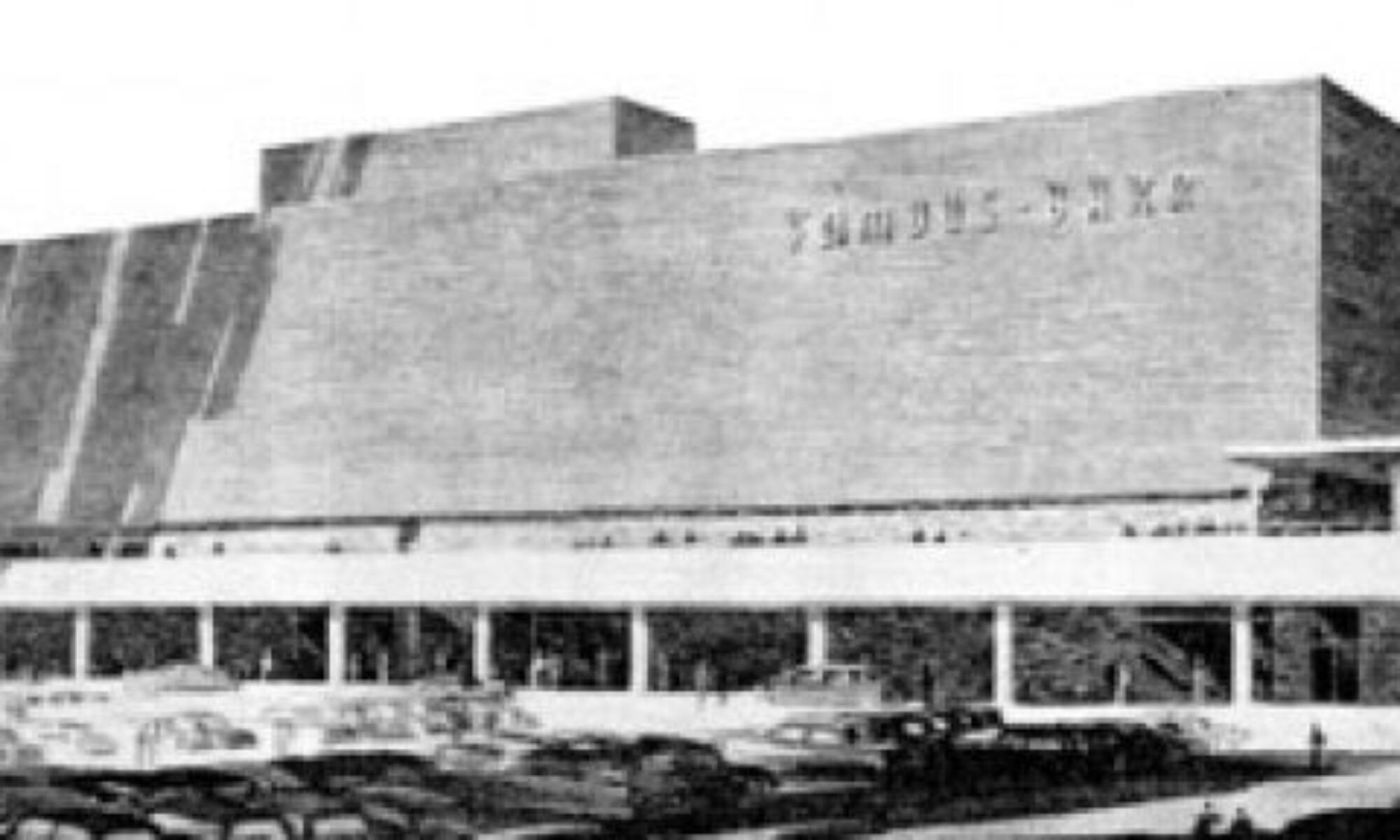

South Grand @ St. Mary’s Dr.
South St. Louis, MO
Here’s a pristine art deco specimen that never gets mentioned when STL architecture junkies discuss the city’s surprisingly large deco offerings.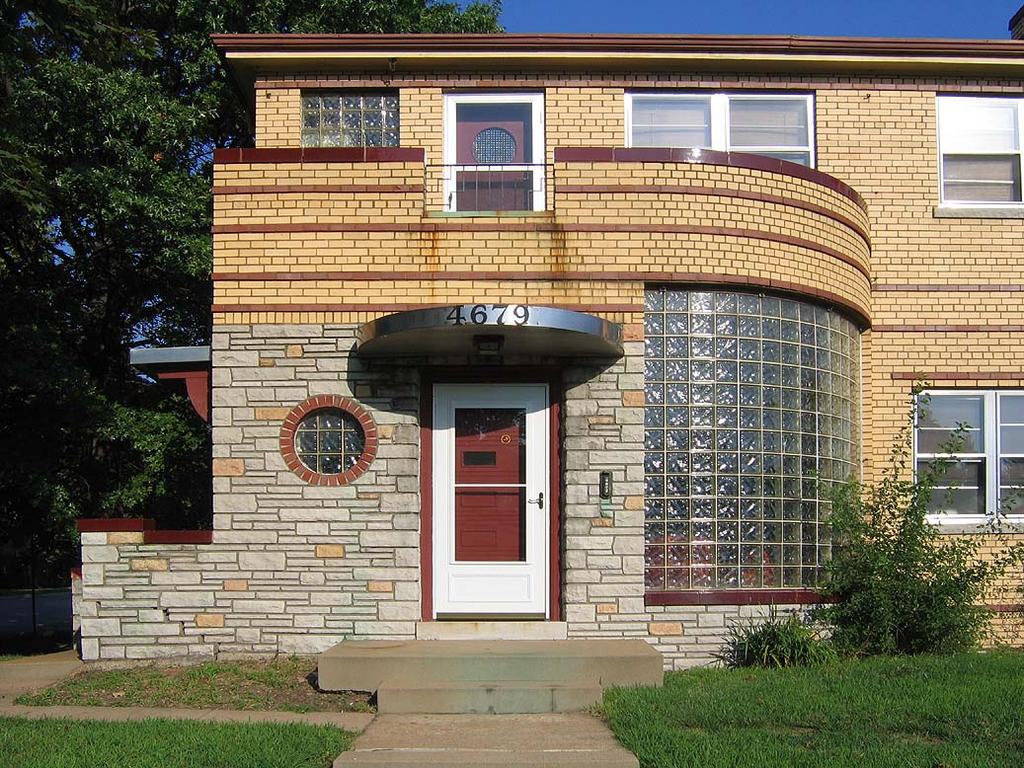
This building falls firmly in the art deco category of Streamline Moderne, with the entry and balcony elements playacting a steamliner. A business occupies the lower level, and 2 apartments are above (complete with in-building garage parking in the back).
As if the grouping of the public and private doors creating a base for the balcony wasn’t enough, we get the added details of a portal window, and curving stainless steel and glass block. All of this is set within your choice of either multi-colored brick or stone. That all of these elements were deftly juggled to create a cohesive whole is a minor miracle.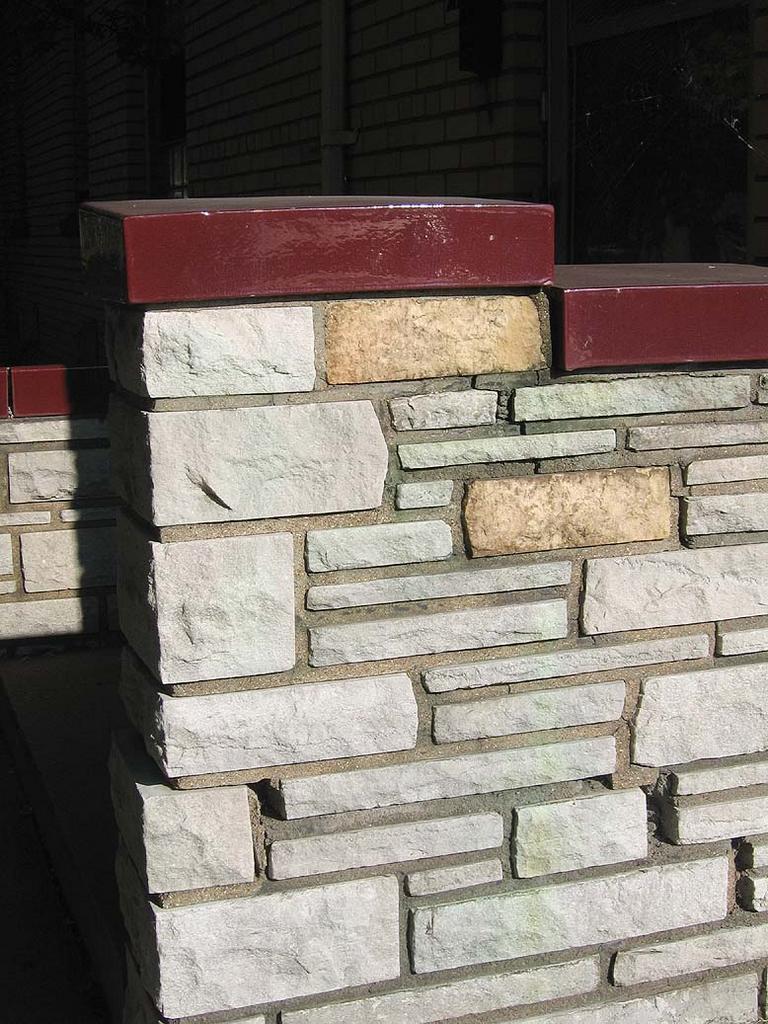
All details are capped with a glossy burgundy glaze, still as bright as the day it debuted, which is a testament to how precise the upkeep is on this building. That’s a sure sign of a proud owner, and I thank you for your efforts.
The Royale Mural
 South Kingshighway & Juniata
South St. Louis, MO
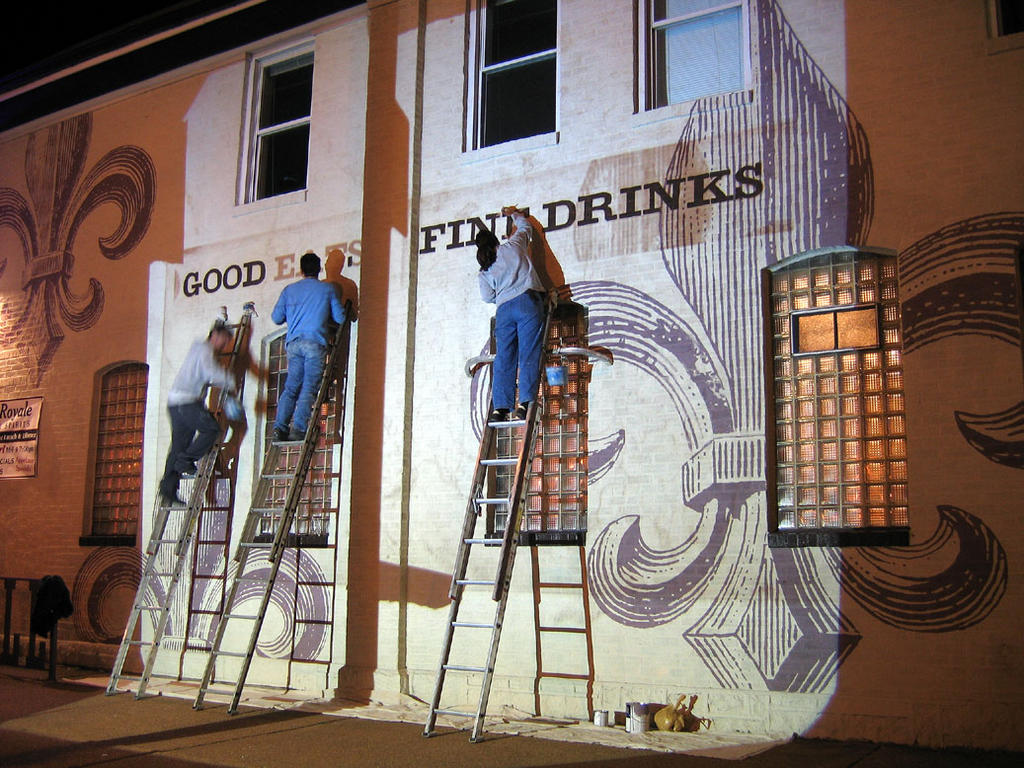
Patrons leaving the congenial warmth of The Royale to head into the crisp fall Saturday night are like deer caught in the headlights. Actually, it’s an old school overhead projector beaming the final piece to the mural on the southern wall of the establishment. 3 ladders abreast for 3 painters diligently filling in as patrons walk by, gawk, comment and stare.
Having painted a few murals myself, I’d been checking out the details of this one every time I walked by it. It’s a deeply textured brick wall, which can be tricky; what kind of brushes were used to get penetration and accuracy? I could never find any guide marks; how did they get the template on the wall? And when did they paint it? for I pass by most every day and never see any painters, just their stately results. So it was a great treat to see the (anonymous to me) artists at work, and have all questions answered in one live demonstration. It was also jazz to see such unique advertising in motion, a spotlight happening, a sidewalk testament to what makes this place so damn great.
The Unexpected

4700 block of Tennessee
South St. Louis, MO
Pedaling through the blocks east of South Grand, and in the distance, I spot the sight above.
Bigger than life-size modern op art oozes out of a vacant spot, and it appears to belong to a florist/greenhouse in the exact middle of a thoroughly residential block.
The stainless steel lettering on the modern addition to the tiny store is way too similiar to the signature of cartoonist John Held, Jr. to be accidental, right?
And even though there is no listing for this business in the White or Yellow Pages, they appear to be fully operational and open for public business.
I’m positive that when that sculpture first went up, the neighborhood squawked like angry hens. But after the initial surprise of the unexpected, it feels right and looks good.
Missouri Botanical Garden

I rode my bike over to the Missouri Botanical Garden to wile away a perfect summer morning. I came in through the pedestrian entrance, and looked for the bike rack. I went towards the main entrance, but saw none. So I tooled across all the black-topped parking lots in search of the rack, but saw none.
From a distance, I spotted a security guard getting ready to open the front doors for the morning; that’s the man to ask where the rack is. I slowly pedaled toward him, keeping friendly eye contact. I was about 100 feet away when he quickly swung open the door and barked at me in a pissed-off father voice, “In the bike rack!” as he forcefully jabbed his finger in an easterly direction.
I looked over my shoulder and didn’t see a rack in that vicinity, but I was too stunned by his manner and attitude to ask for clarification. What’s his deal? I pedaled off in a perplexed manner to find this rack, and no wonder I couldn’t find it on my first pass through.
It was way over in the north front parking lot, camouflaged in battered old paint and tape so that it blended in with the black top and white stripes. It looked like they swiped it from a schoolyard, or something, but oh well, at least they have a rack.
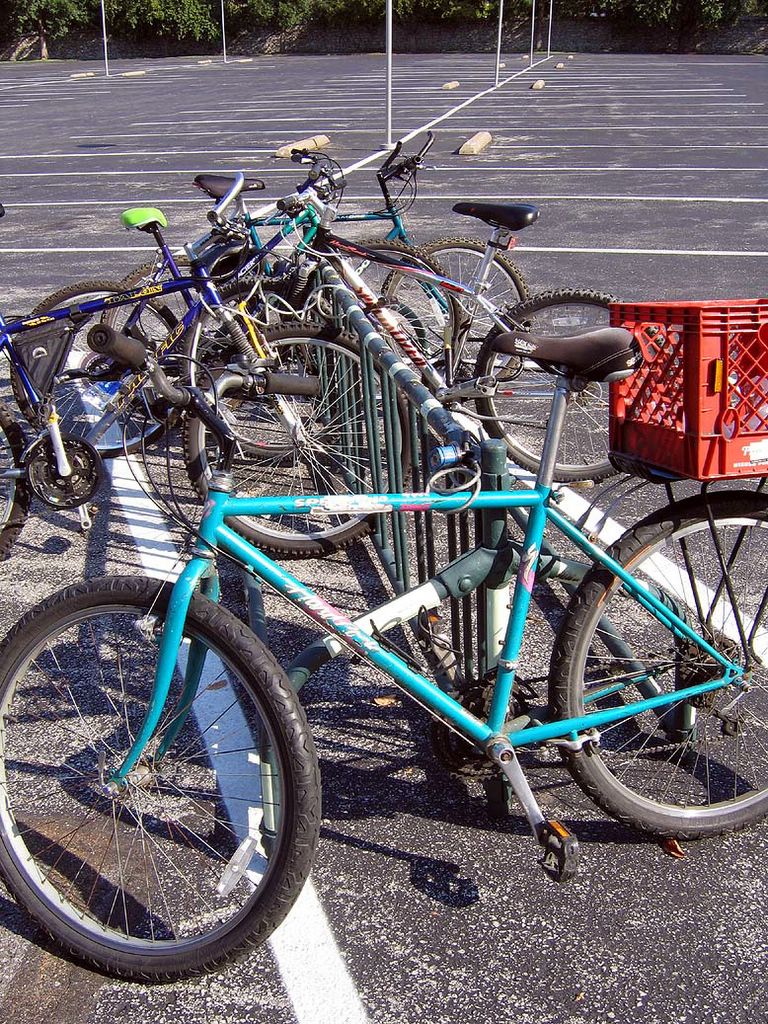
As I put my bike in the rack (above), it rocked.
What? Is the bike rack moving? A tiny push caused it to scoot away from me. I kneeled down for a closer look, and sure enough, the rack isn’t screwed into the ground! Just perfect. Not only is it poorly placed and junky, but it’s unsecured!
Two people with a pickup truck could come by and scoop up this rack and its contents!
It would be safer to chain the bike to one of their trees, but then Surly Security Guard would really throw a fit, wouldn’t he.
MoBot is a class act all around, but this gruff and cavalier attitude towards bicyclists is completely unacceptable. Their actions show they’d prefer I visit on foot or by car, and while they are masters of botany they are not qualified to dictate my transporation options. I indignantly pedaled away.

Over Labor Day weekend, I returned to the Garden to document the Bike Rack Debacle. Because the man pictured above was on the phone the entire time he was locking up his bike, I didn’t get to make snide comments about how 2 men in a Ranchero could steal all these bikes.
But I did notice the bright blue bike with the bright red milk crate strapped to its rear. Also note that the other 4 bikes are as far away from it as they can get. That’s because everyone knows that a milk-crated bike belongs to an elite group of old men cyclists.
I now belong to the milk-crated bike ranks.
Rather than bright red or burgundy, I opted for a relatively sedate dark gray crate, but I have infiltrated their ranks, nonethless. And I couldn’t be happier. Rather than groceries, books and cameras hanging from my person, I just throw everything in the crate and pedal on.
But not to MoBot, no thank you.
We Brick This City
Since St. Louis is tearing down modern Busch Stadium for a big brick ball park, viagra then it makes perfect sense to brick up a modern downtown apartment tower built around the same time, right?
Obviously, St. Louisans live in fear of modern architecture, because a project architect for Gentry’s Landing said, “What we are trying to do is humanize the building, and make it seem more approachable and more pleasant.” Local developers feel this can only be accomplished with brick, brick and then some more brick.
It was the World War 2 generation that instituted Urban Renewal, which translated into most major cities erasing thousands of acres of Victorian buildings in order to erect thoroughly modern commercial shrines to a progressive space age future.
In St. Louis, a notorious chunk of Urban Renewal failed miserably, but after the blacks and the Chinese (sorta) recovered from the trauma of being so abruptly displaced, the area that is now the Gateway Arch, Pet, Inc., Mansion House, Gentry’s Landing, KMOX and Busch Stadium has worked pretty well for the last 40 years or so.
Now a younger generation begins to erase the initial erasure, and, naturally, nothing makes as unique and contemporary a statement as brick. So, down comes the white, arched concrete of Busch Stadium for a wide pile of bricks . Hide the large expanses of Gentry’s Landing glass behind a tall pile of bricks. And if we’re lucky, they’ll tamp down all that shiny stainless steel and brick up The Arch!*
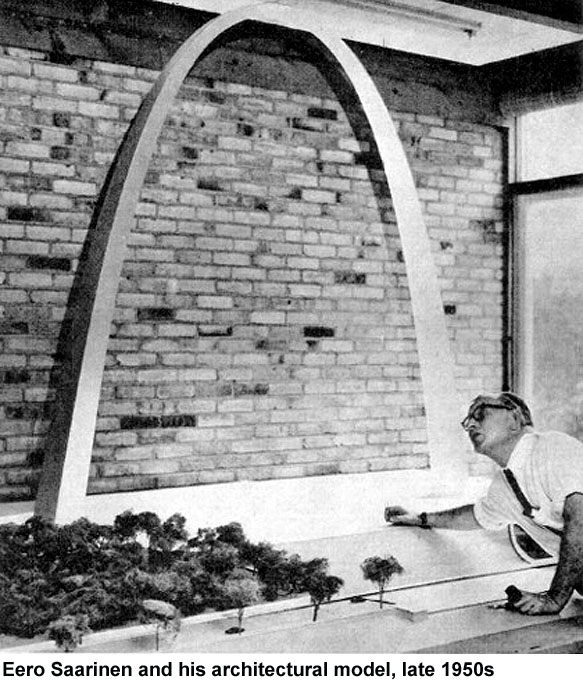
*An architect pal said that what ultimately protects the Arch is that it’s nearly impossible to lay bricks in a catenary curve. Antonio Gaudi could do it, but he’s long dead and gone. Whew!
Northland Demolition Part 4
July 31, 2005
The last visit was July 26th.
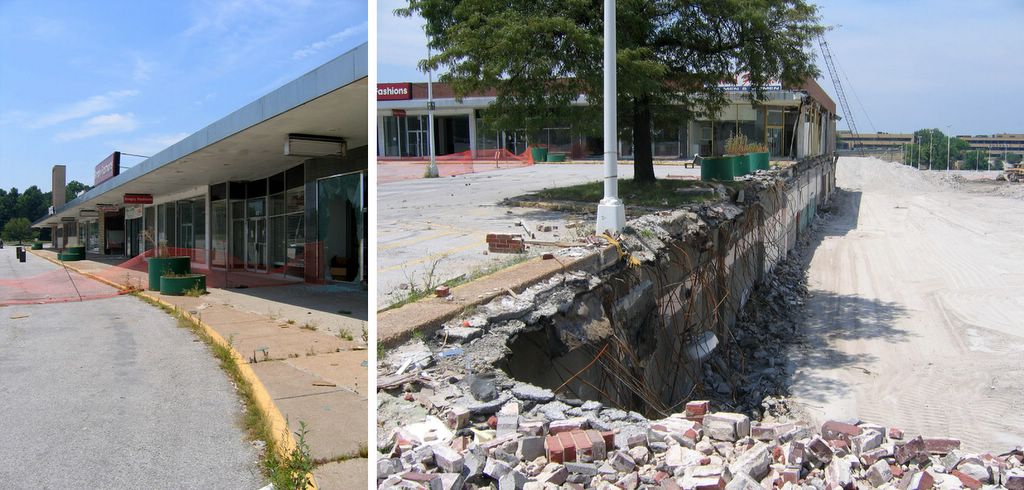
And with the former Famous Barr building utterly gone and buried in a massive pit (above, right), the demolition crew got busy on the north arm of Northland.
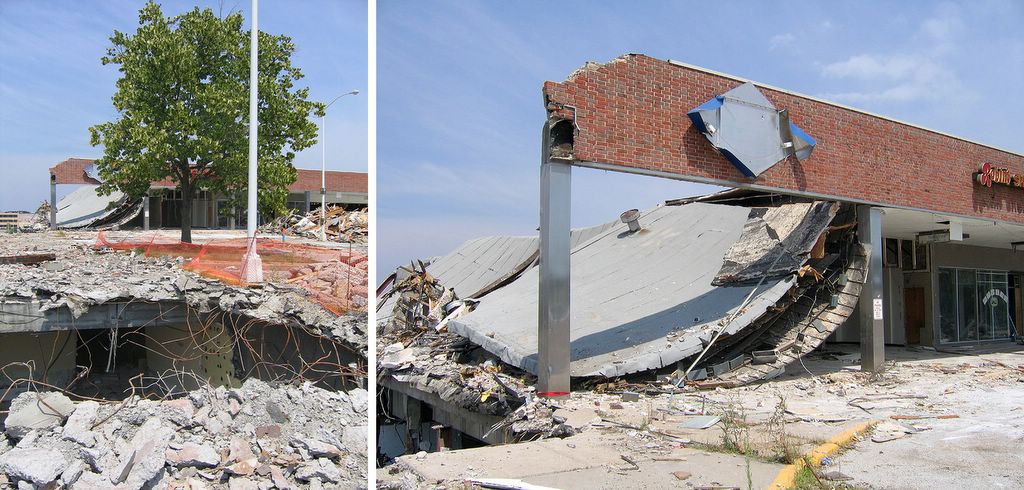
(Above, left) In the foreground, we’re looking down into what remains of the Famous-Barr upper basement as we stand on the upper parking lot. And what are the tree roots growing into? I never comprehended the complexity of Northland’s multi-levels until it was dismantled, and I’m still impressed with the designers’ ingenuity.
(Above, right) The former Baker’s Shoes gets a good medicine ball whack before the crew went home for the weekend.
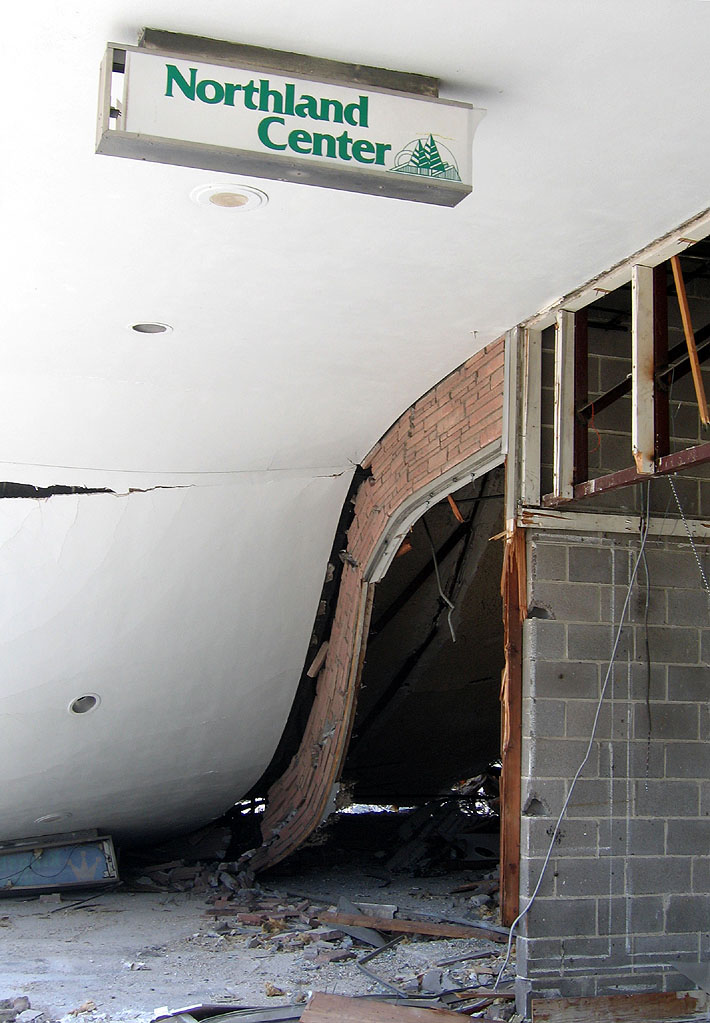
Demolition debris can’t help but be poetic in its descent. In person, the flow of the plaster and brick (above) was balletic.
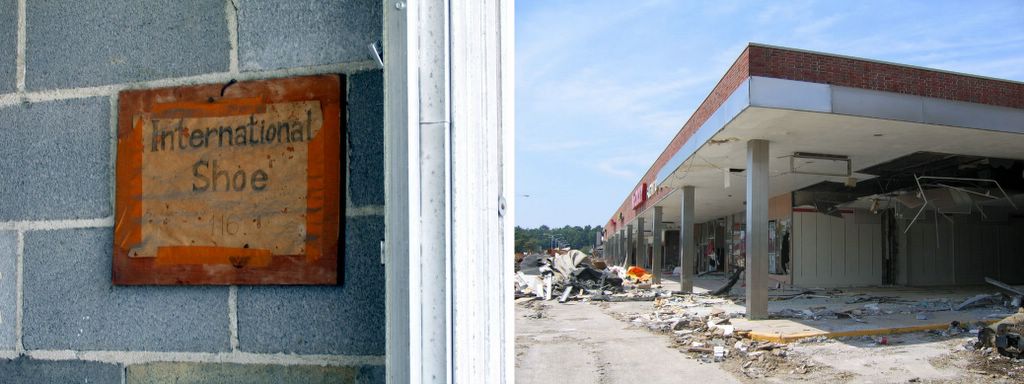
It’s hard for me to watch them take this building down, but tearing it down also reveals the older layers I remember, and hidden layers that the public was never meant to see. The southern next door neighbor of the former Kresge’s was obviously an International Shoe at the time the place was built. This wooden construction plaque (above, right) had been buried behind the original drywall.
The former Kresge itself (above, right) revealed a few hidden treasures, and unwillingly gave up a few more pieces for me to cart off. Kresge’s is such a special and mythical place for me (and some others, too), that I will post a separate farewell entry to Northland’s Kresge’s in the near future.
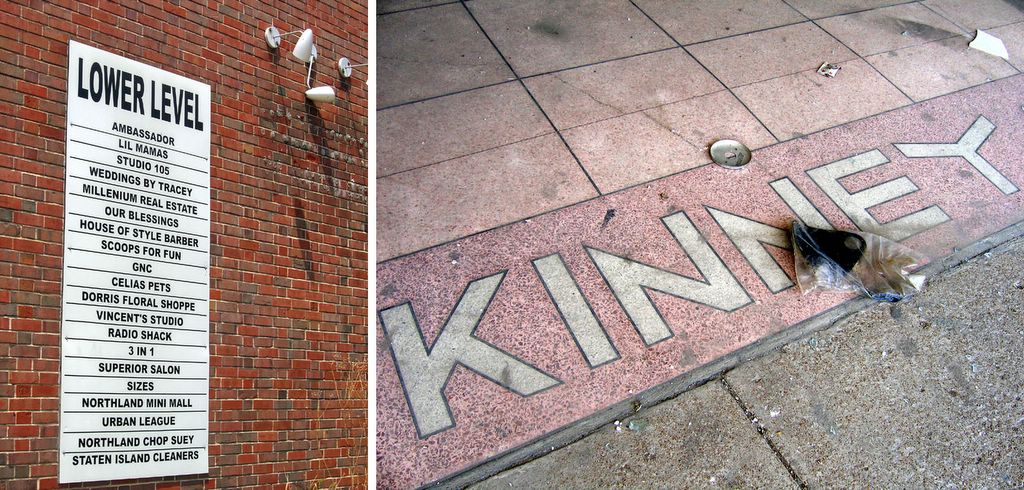
As we head down to the lower level, a sign (above, left) still recalls what shops were there right around the time Famous Barr vacated in the very early 1990s.
And Northland was obviously shoe shopping mecca with Kinney (above, right) being one of two stores that permanently marked their footware territory in concrete. The clothing store Worth’s had done the same, and it’s always a thrill to find store logos embedded in entry ways. From small towns to large cities, it was assumed that a shop would always be in that location, so it was no problem to pay a little extra for some sidewalk branding art.
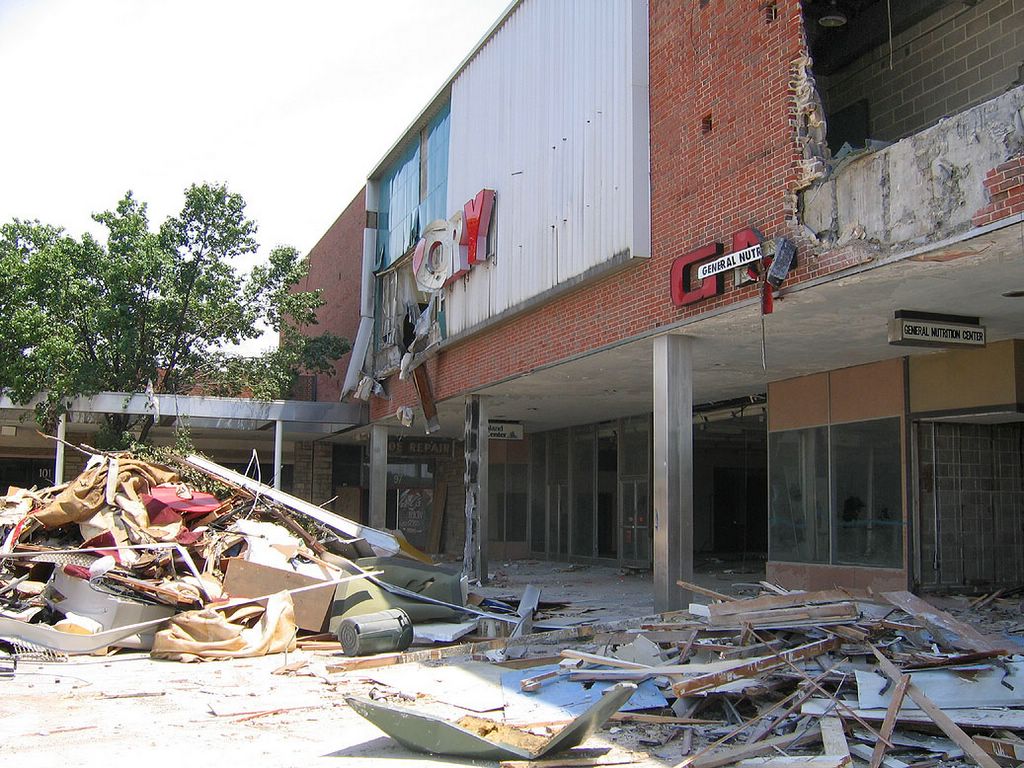
To aid in asbestos removal, the demolition crew blasted a hole into the west wall of the top floor of Kresge (above), and by doing so, they revealed the deep aqua blue tile of the original facade. Actually, all shades of light to medium blues, in concert with all that stainless steel, was the dominate color scheme of Northland. Hmm, wonder where my inbred love of a light blue and silver color combo comes from…?
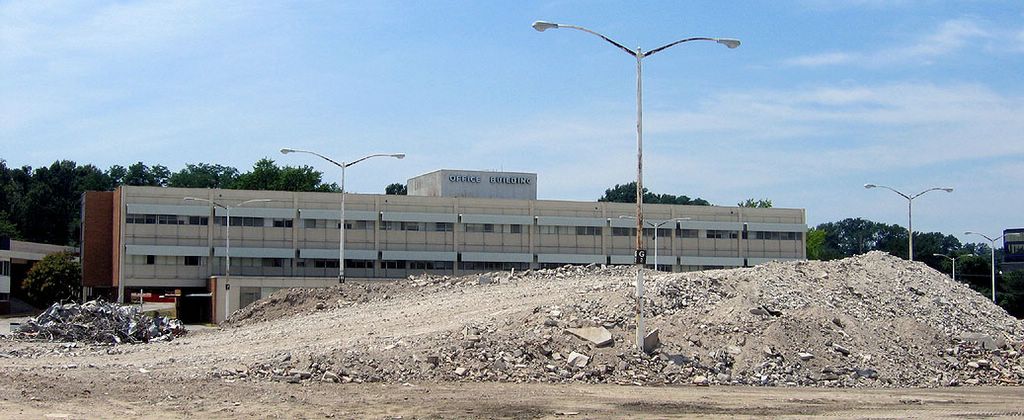
Here was a sobering moment.
A rubble mountain had sprung up in the middle of the lower level parking lot (above). At peak, it’s easily 25 feet tall, possibly taller, since I’m lousy at judging height. It’s a rather long ascent, and once at the top it does provide fantastic photographic views. Then it hit me:
These are remains I’m standing on.
All the busted up concrete and plaster they pulled out of the Famous Barr pit made this temporary landmass. And suddenly I was creeped out and ashamed to be standing atop it.
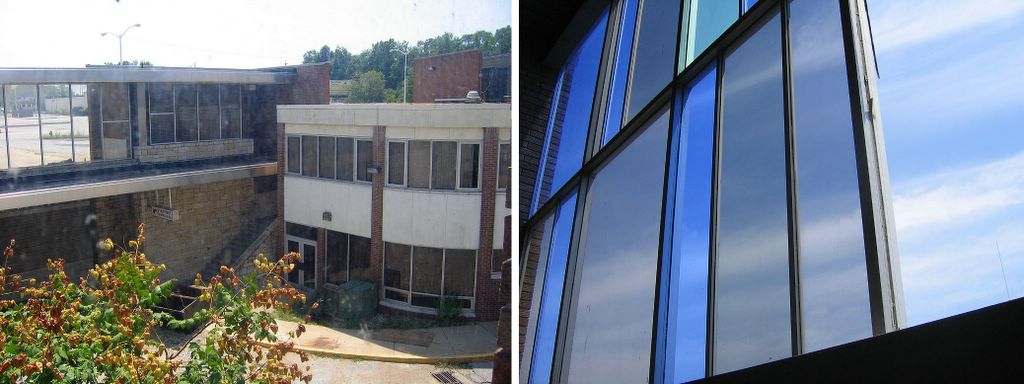
Got a good perspective on how the upper and lower levels of Northland come together on the southernmost end (above, left) by standing in the outdoor utility stairwell of the Northland Office Building. The patchwork of blue glass that makes up the exterior walls of its stairwells (above, right) are pretty banged up, with some panes missing, but it’s still breathtakingly beautiful to my eyes.
August 13, 2005
I was going to Northland at least once a week to survey, spelunk and photograph, but it started to weigh heavily upon me. So I let some time slip by, to give myself a break from the emotional burden. But I needed to get back with camera and tools to try and salvage as much of the Kresge as was possible for one girl to cart off. I desperately wanted to find something that said Kresge on it, just to have proof that it really existed.
The moment I got off work on this particular Saturday, the sky erupted into a mad, blazing storm that eventually caused massive wind damage and flash flooding throughout most of the St. Louis area. But I drove on, hoping a storm this wicked would quickly blow over.
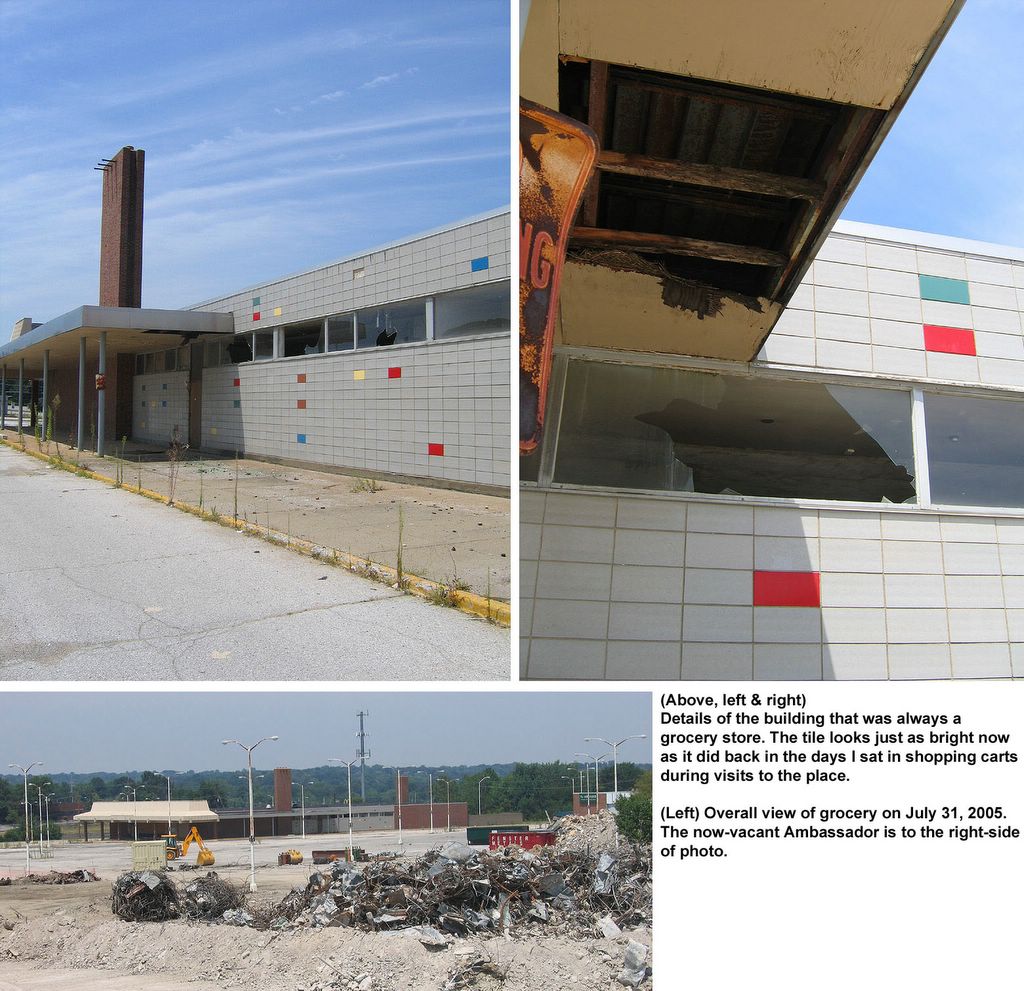
And I wondered if the grocery store would still be there. Pictures I’d taken of it on my last visit are above.
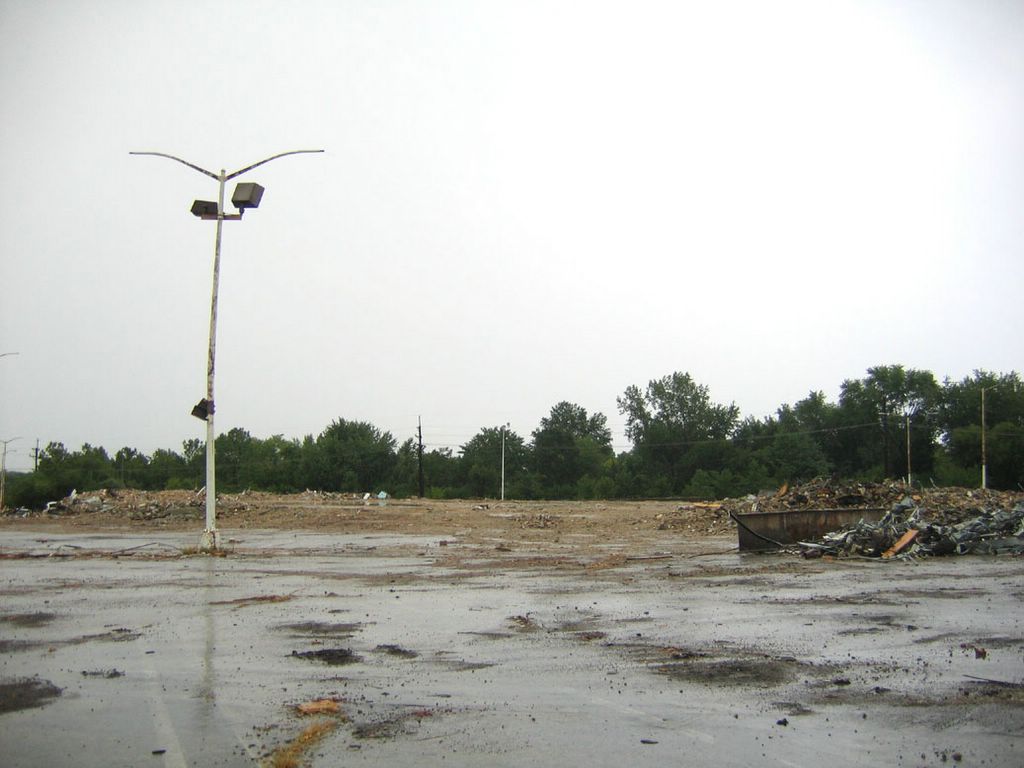
It’s still an incessant downpour when I barge through a “Do Not Enter” gate, only to find this empty void among the debris (above). The grocery store was history, vanished into mud. I had so wanted to rescue one of those obscenely bright glazed tiles, but those had probably been ground into dust about 4 days ago. Now it was part of the oozing paste in the hole that was once a grocery store.
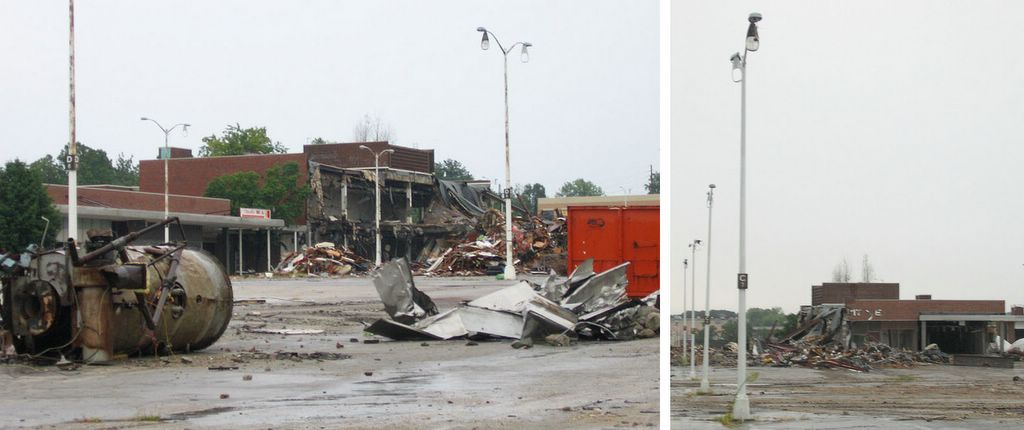
And quickly looking to my right, I see that exactly half of Kresge was sliced off (above, left)!
Now, it’s pouring down rain. I have no rain gear and a digital camera that’s allergic to water. I’m stuck in the car until it stops raining. So, I drive around Jennings and Ferguson for about 30 minutes, wondering who’ll stop the rain?
It never stopped.
In the upper level Aldi’s parking lot, I forlornly stared off into the dreary distance at what was left of Kresge’s (above, right). I couldn’t get to the building and its remains, and even when it stopped raining, it would be a toxic muddy mess. I also contemplated the irony of how Northland was now offically 50 years old, making it eligible for Historic Registry…yeah, whatever.
Water dripped down my windshield and my face; I knew it was over for me and Kresge. This was not how I wanted to say goodbye, but that’s how it ended.
This is all becoming too much of a heartache.
August 21, 2005
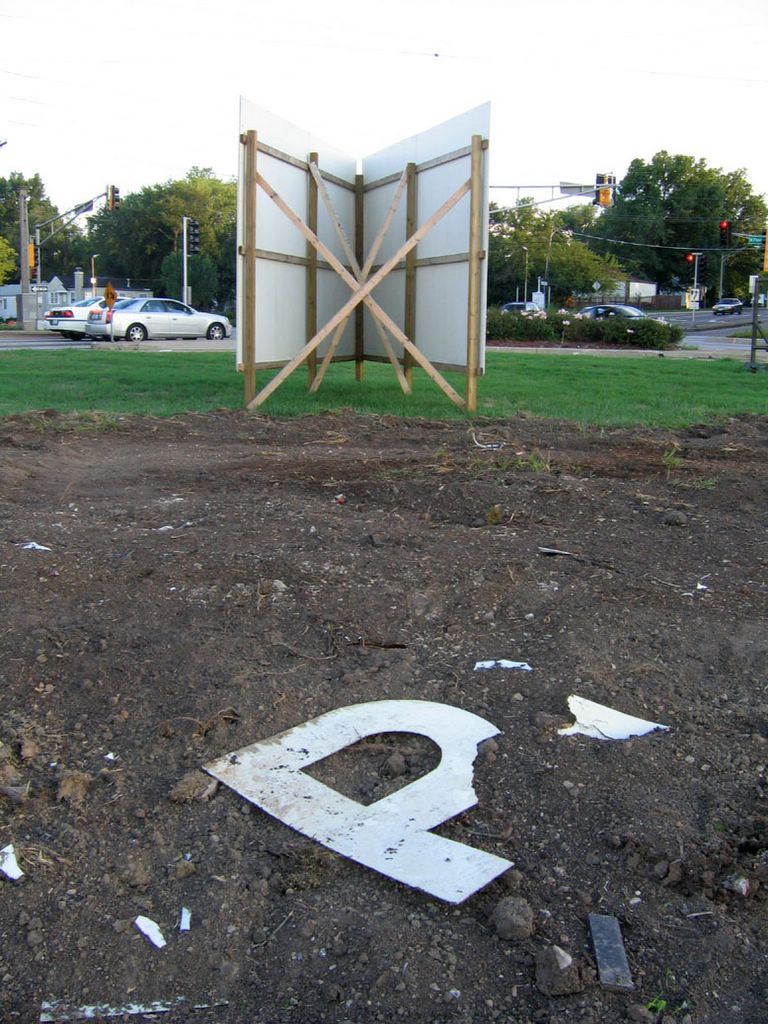
I return a week later and immediately notice that the large and elaborate Northland sign that officially greeted everyone at the the Lucas & Hunt/West Florissant intersection had been – literally – smashed into the dirt (above). They hadn’t even bothered to cart away the plastic letters, so what remains of the “R” seen in the foreground is now in the trunk of my car.
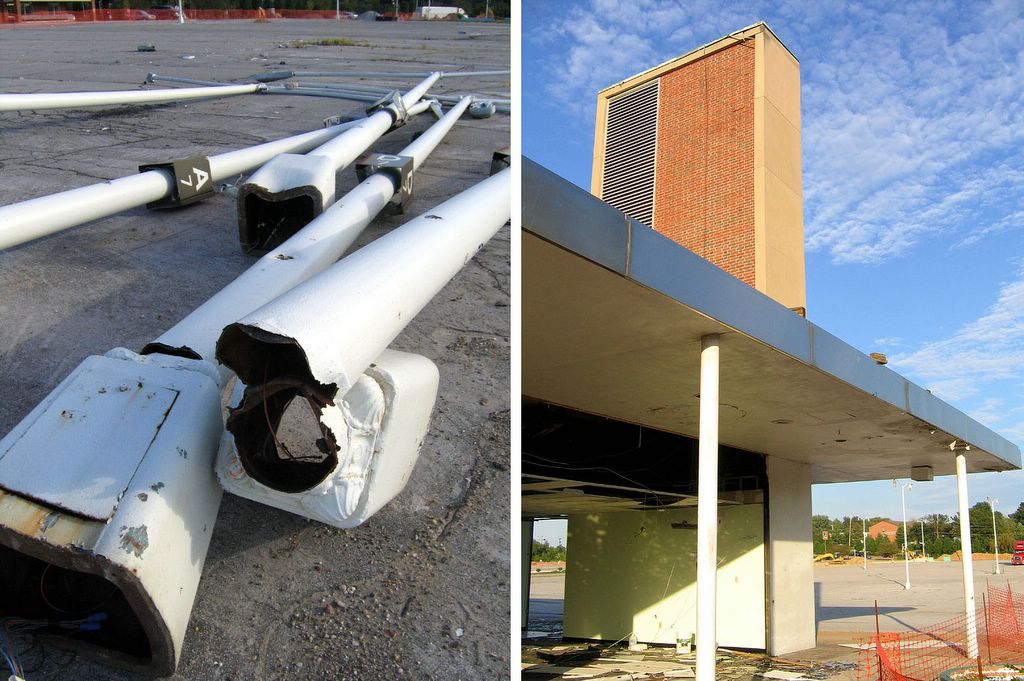
The crew made a broad sweep across the upper parking lot, knocking down rows of light poles (above, left). It looked a bit like a razor had run across a beard, and left a fine layer of broken glass everywhere, like powdered sugar on a lemon bar.
The tower that accents the south arm of Northland (above, right) is still standing tall, but they have prepared the store fronts for the final blow by removing all glass and interior contents.
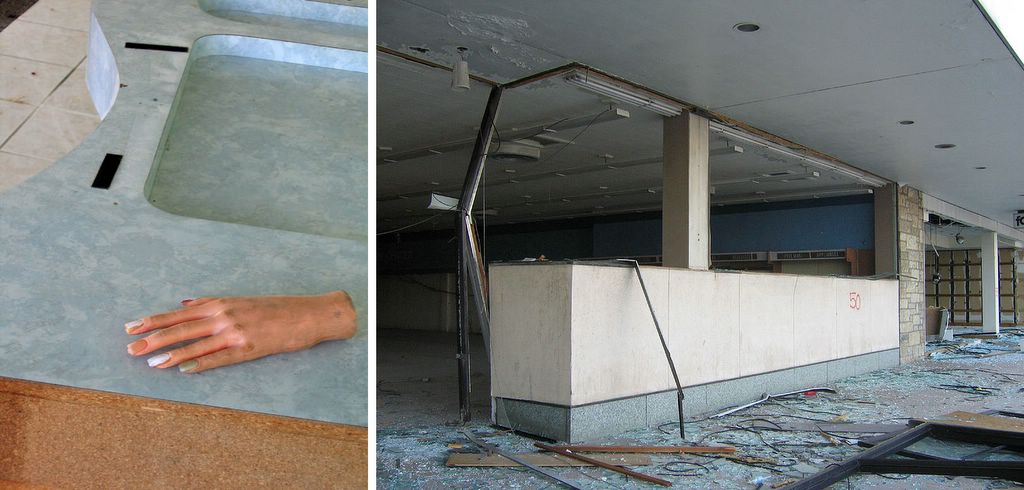
The detritus of demolition has featured many a poignant and/or odd sight (above, left).
And the “opening up” of the former Walgreens (above, right) once again reveals how airy that space had once appeared from the sidewalk. With a footband of blue green tile, topped by panels of smooth stone and bookended by flagstone columns, it was certainly the most sophisticated Walgreens store, materials-wise.
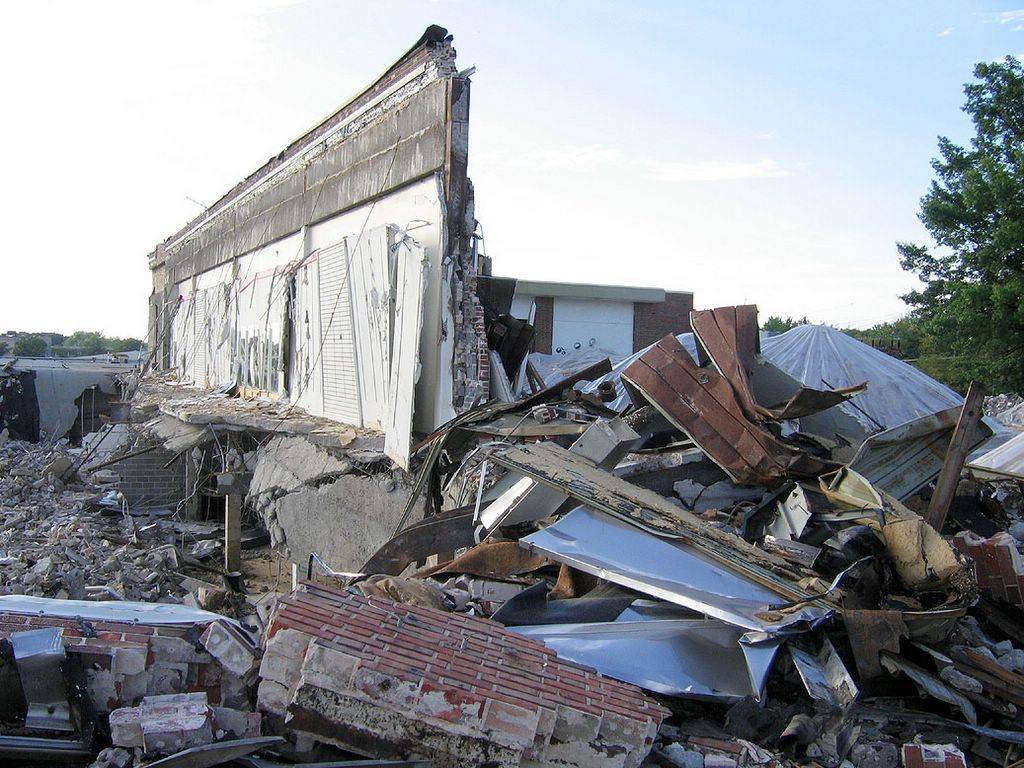
With heavy heart, I made the trek across the wreckage of the parking lot to where Kresge once stood. On the upper level, it’s northernmost wall still stood (above), reminding me of some ancient ruin as it stood among its fallen parts. I stood for a long while in these remains, but didn’t have the heart to poke around for treasure. I was a bit too numb.
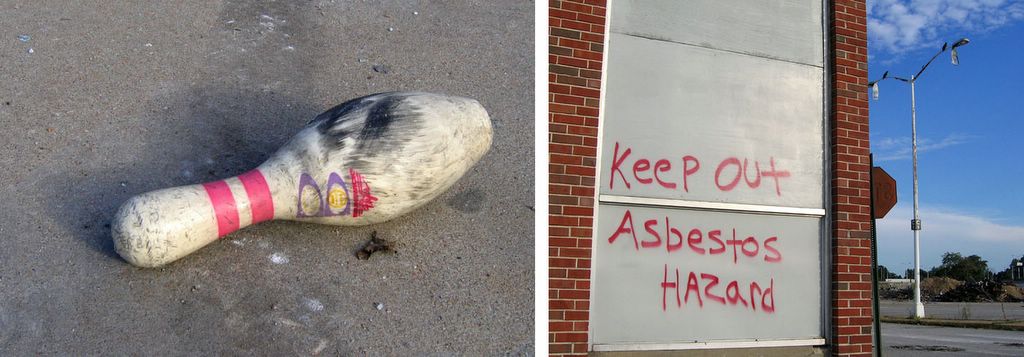
So I walked around and down to the lower level. The space that was the Ambassador nightclub was formely a bowling alley, and since they were currently crushing it, long-buried bowling pins (above, left) were scattered among the asbestos-crusted construction shards.
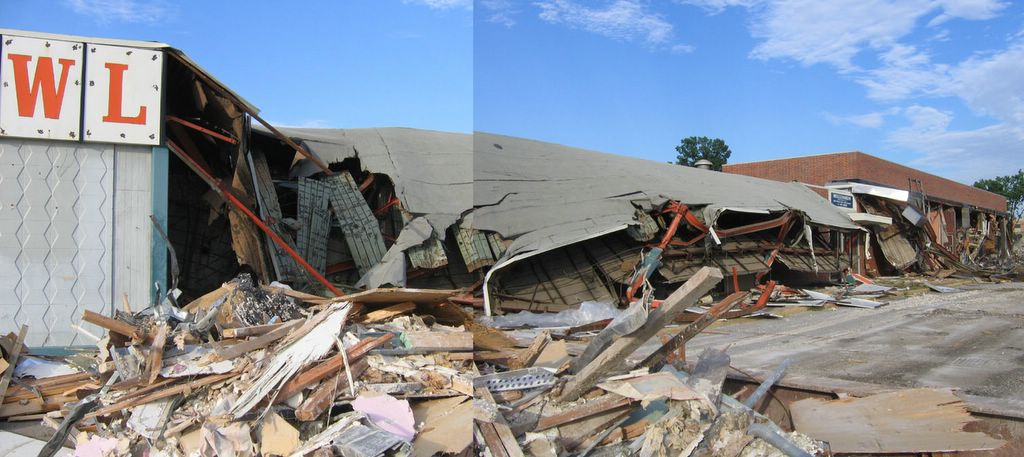
The lower level West arm in the middle of being beaten to the ground (above).
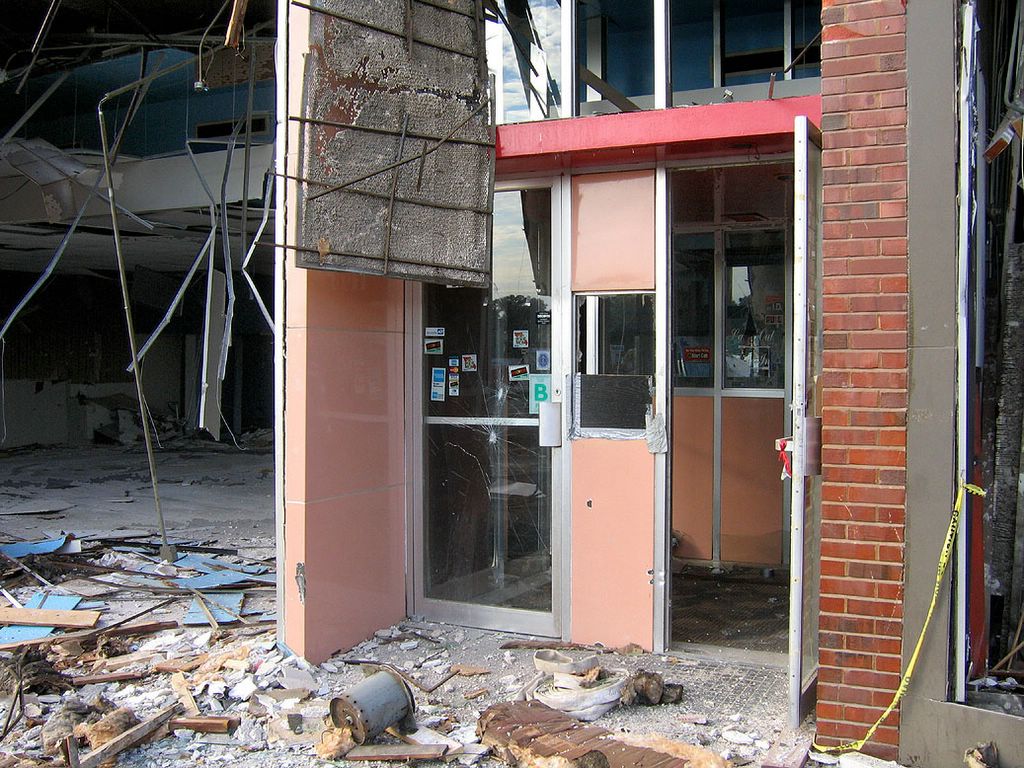
So far, this sections demise has been the most colorful, because these store fronts had retained more of it’s original store fronts, including the coral pink Vitrolite (above).

Here comes another sobering moment.
(Above, left) This area tucked under a “lattice work” stainless steel canopy once housed a popular music store, a cobbler and Worth’s clothing store. To the right of this picture (taken about a month previous) is the lower level Kresge display windows.
(Above, right) Standing in roughly the same position, the tree is still standing and…that’s about it. And here’s exactly where it became too much for me to bear…
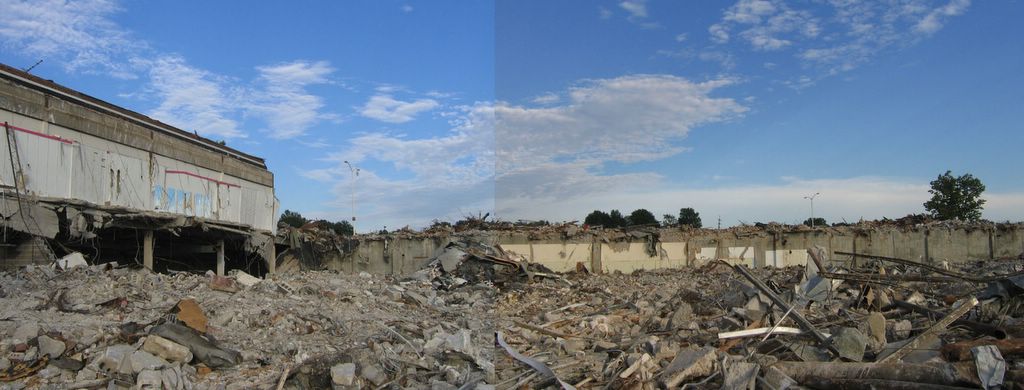
As I stood ankle deep in the rubble (above) of what was my beloved Kresge, I literally lost it. I doubled over with stomache pain and cried and wailed with grief. And it surprised me.
I’ve been surverying and photographing Northland since March 2002. Away from the site, the sentimental angle takes over, but while “working the site,” my historical, architectural and photographic eye is in play. I seldom get too too emotional about it because I have documentation work to attend to. But at this very moment, my heart broke into a hundred pieces and tears literally dropped into the dust as I bent over trying to catch my breath. The eternal “goneness” of it all hit me too hard, and at the wrong time. I just lost the strength or the urge to continue on. I just wanted it to be over, because I was tired of smelling, seeing and shooting the corpse. I was numb from attending The Longest Wake.
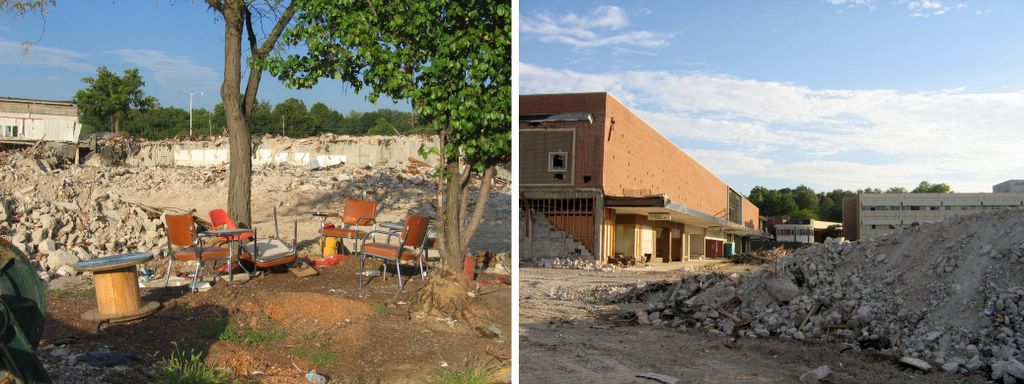
Maybe ten minutes later, the emotional drama and physical drain subsided and I trudged on. I’d come too far in this self-appointed project to stop now.
And we find Lunch Among the Ruins (above, left), and the Rubble Mountain becoming just as wide as it is tall (above, right).
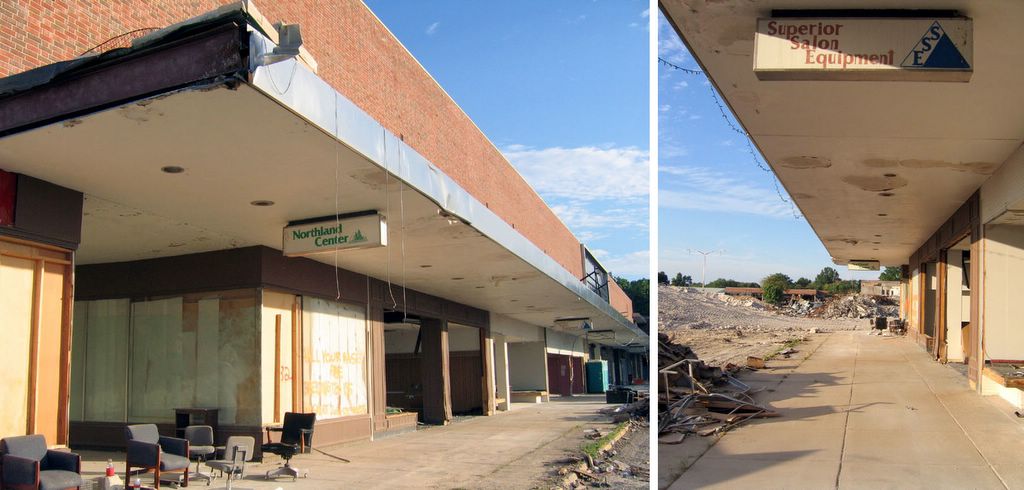
The lower level of the South arm is also prepped for crushing (above, left & right).
And I marvel yet again at the massing of space and place that is just one of the West Florissant entrances to Northland (below). It literally looks and feels like a section of any downtown city.

September 4, 2005
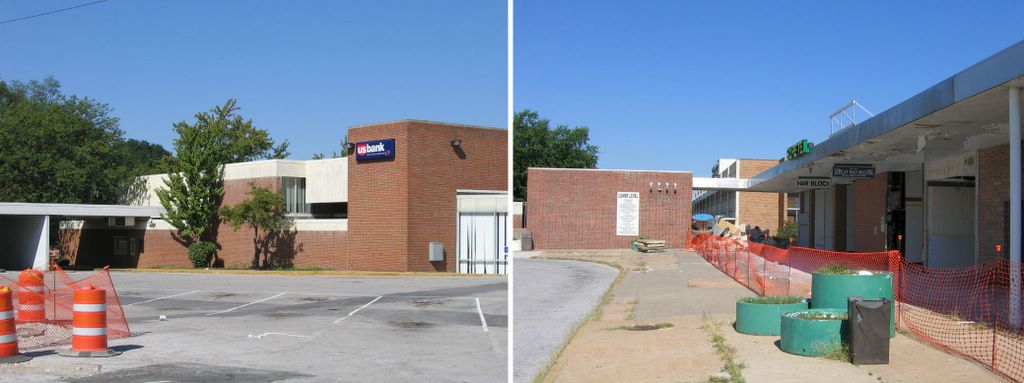
Oddly enough, the bank (above, left) is still open for business. Obviously, money talks. But how creepy is it for the folks working there?
When we invade the orange plastic fence boundary (above, right)…
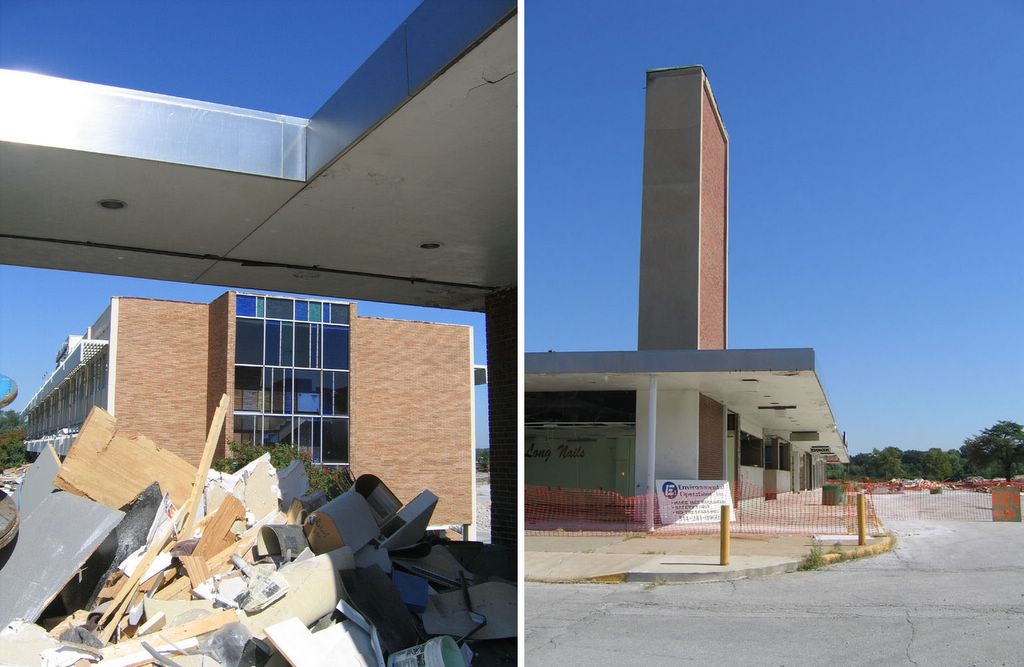
…to check out the deconstruction details. There is now an unobstructed view from the upper level to the Northland Office Building on the lower level (above, left). And has been their consistent policy, the demolition company places their sign (above, right) on the section that will be crushed next. This tower is the last remaining sign post of the main shopping center. It’s obliteration will be another sore point for me. Not looking forward to it, while also wishing they’d just hurry up and put the horse down…
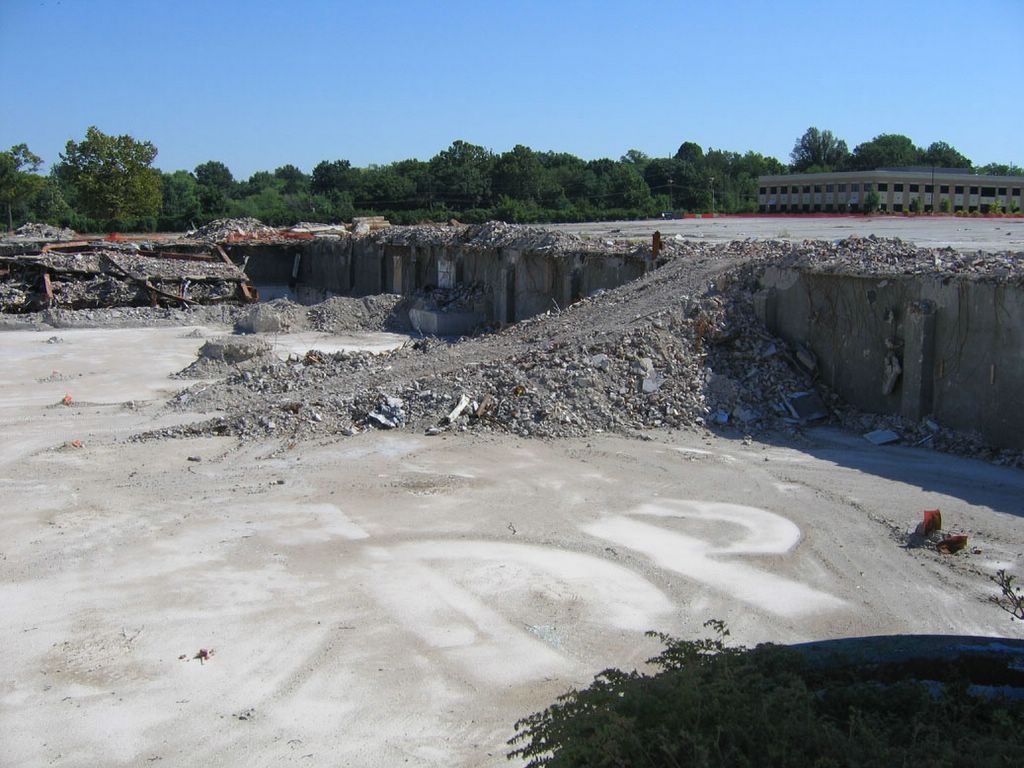
Where Famous Barr was (above) is now filled in with all its own remains. This area was 3 stories deep. It’s now maybe a half-story deep. And looking across north, it’s just flat ground. It’s depressing. But at least it’s over.
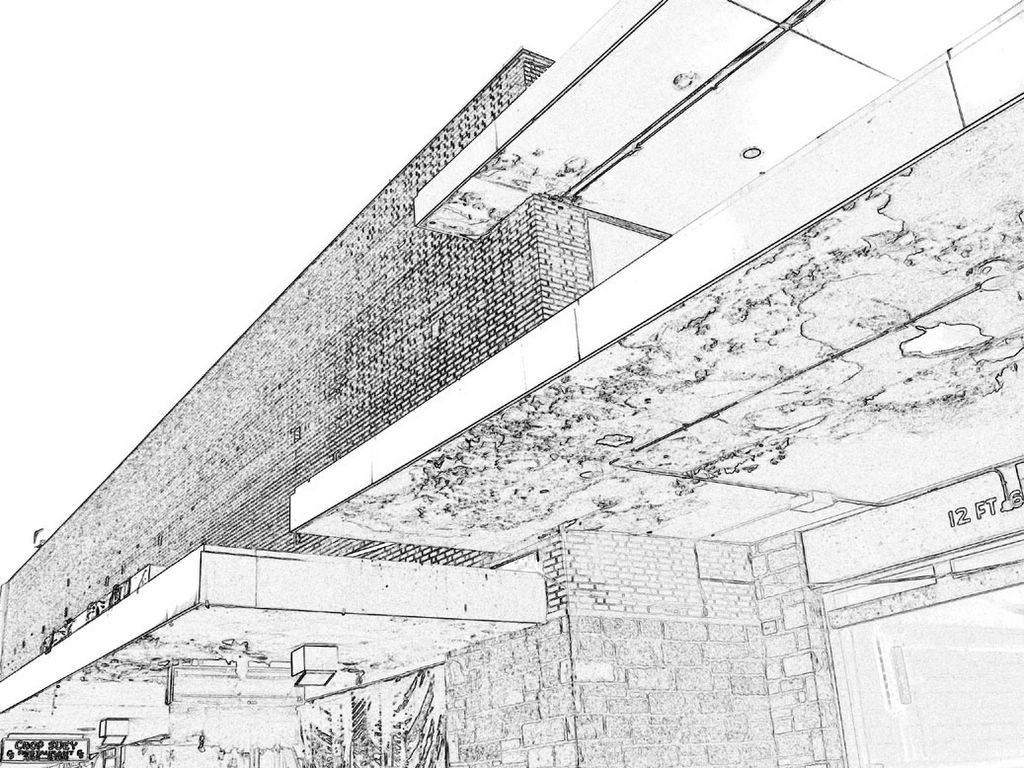
Southernmost lower level “sketch”, above.
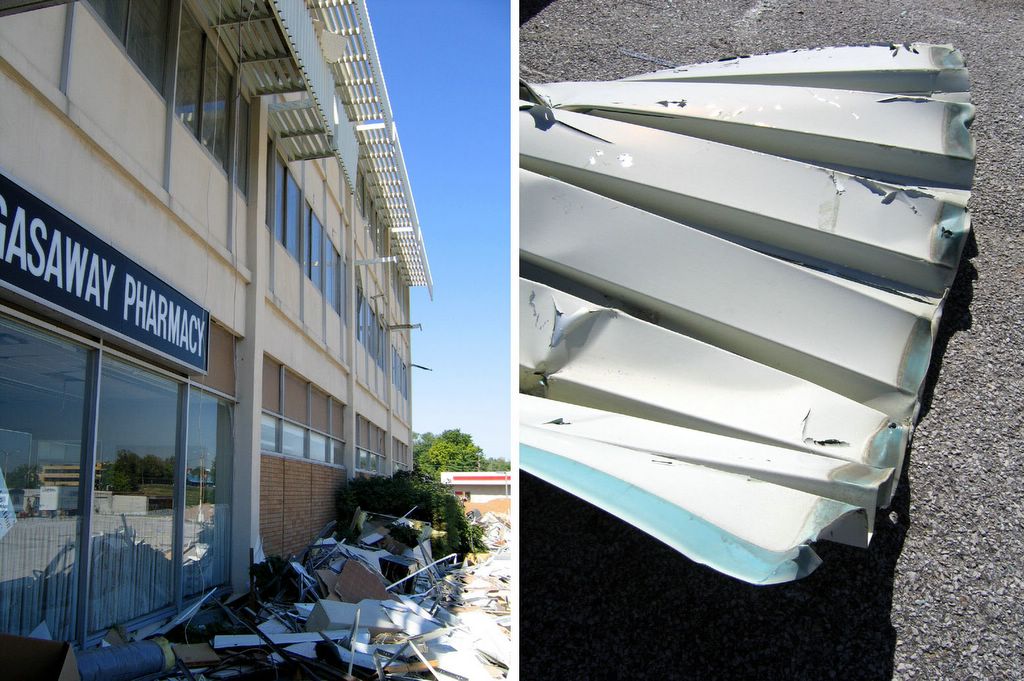
The demolition crew was using Office Building as it’s cool zone during the intense heat wave of early August. But now they’ve begun stripping and throwing out the interior of the building, leaving a ring of trash along all sides of its perimeter (above, left). And they’ve begun peeling off the the metal sun screens that gives the building its distinctively modern look (above, right). Paint lines show these panels were once blue green, but I don’t remember that at all. Though the thought of this color in horizontal bands against the white building sounds appealing. Many people mistakenly assume that modern architecture means stark white, and from Le Corbu to Northland, that simply wasn’t the case. Color and texture played a large part in shaping the spaces.
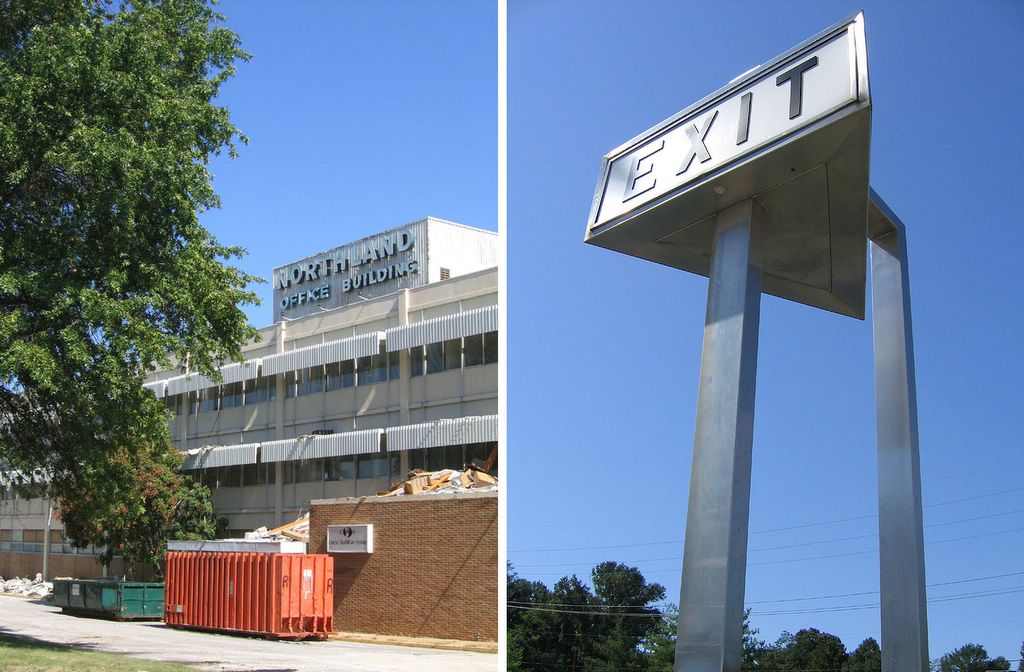
(Above, left) Hauling in the dumpsters also means the medicine ball is coming. I’m positive this is my last moment with Office Building (and a solo entry on it will also be forthcoming). I’m in no hurry to get back to the site because it’s just too large of a brain and heart drain. Almost 3 weeks weeks will pass before I can get back, and this demolition crew is fast and effcient. Everything will be gone by the time I get back. I dread the moment, but I will return.rf
Porter Paints
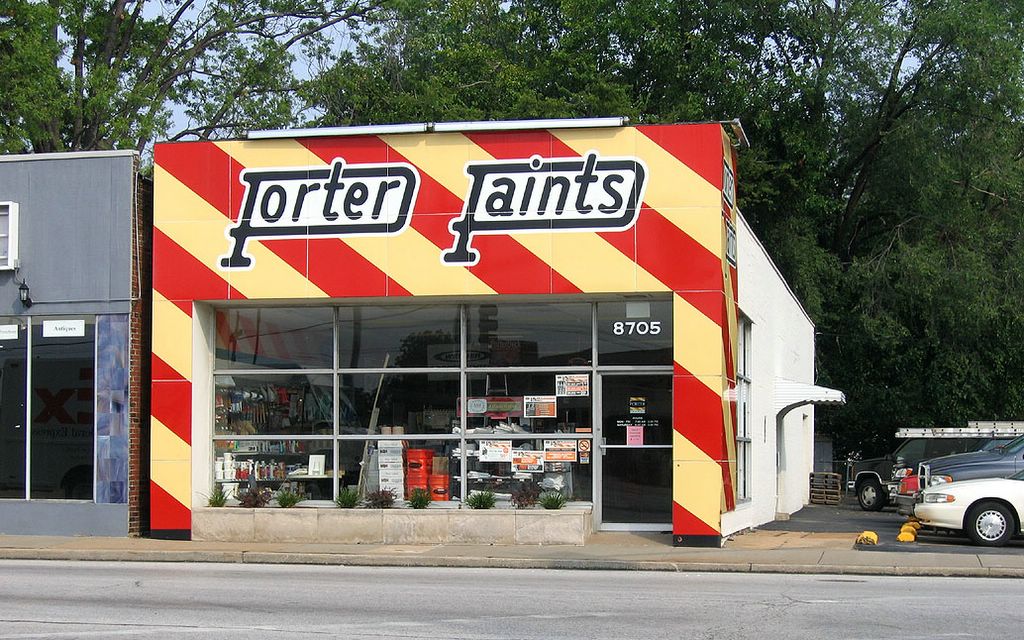
Big Bend & Elm, Webster Groves, MO
I ran across an ancient metal can of Porter Paints mineral spirits, and realized they haven’t changed their look ever. In today’s climate of corporate branding and re-branding, that’s quite a rare achievement.
Their stores still retain the distinctive yellow and orange stripes. So bright, so obvious, so steadfast to the old fashioned way of physical advertising.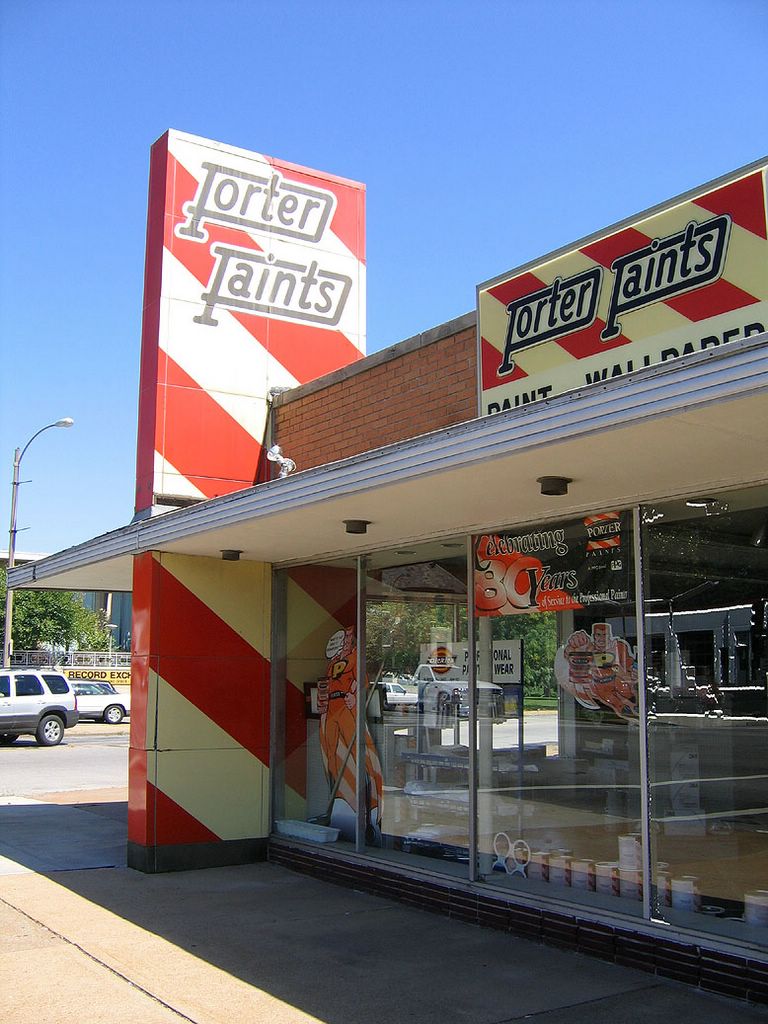
Hampton & Eichelberger, South St. Louis, MO
The Porter facades are easily adaptable to any type of commercial building, which makes for interesting variations on the theme.
I can’t find any information on them, so I don’t know the answer to these questions:
Are new franchises required to sport the facade? How do they order the facade, and how many styles to choose from? Can I order one to spruce up my garage?
Vive le New Orleans
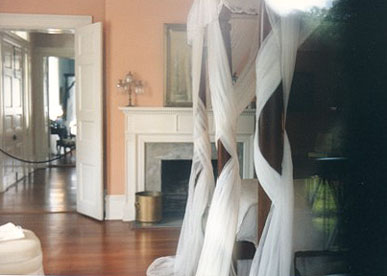
New Orleans & Vicinity
As seen by my camera’s eye and heart through the years
I’ve been to New Orleans a number of times, and according to previous test results, it’s nearly the ideal spot for me to live. The part of my heart that forever stays in New Orleans is broken and bleeding, pumping with towering anger.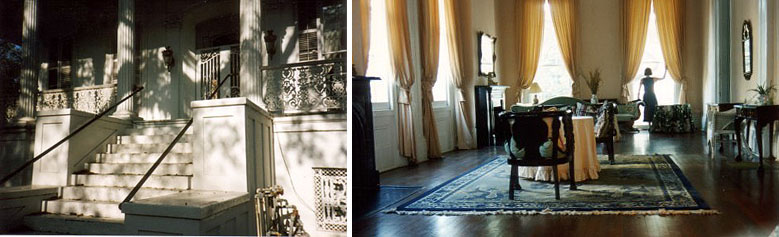
You just know that every government official who “fiddled while Rome burned” has partaken of New Orleans supple, sultry charms. When the survivors of the city and its surrounding bayou country dries off and regains strength, hell hath no fury like a lover scorned.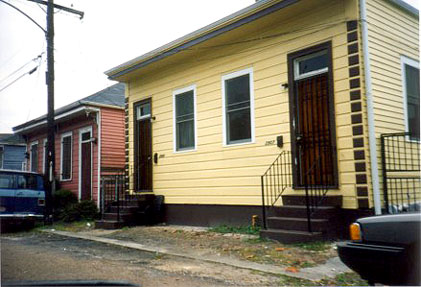
There is an acceptable level of decay in New Orleans. There has to be, because the humidity makes fast work of even the freshest coat of paint. The forsaken 9th Ward (above) is just as engaging as the spared Garden District because of the endless coats of riotous color – ever-changing hues in a continuum of life/death/rebirth.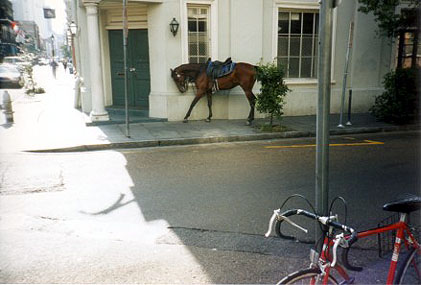
Horseback, bicycle, streetcar, foot… so many social ways to get around a city of relatively small square miles with a large, soulful heart. To live and die by a gallon of gas in a motor vehicle is a tragically unjust ending.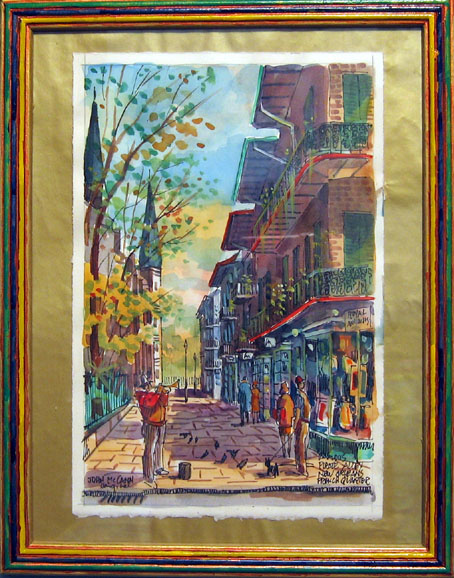
A watercolor bought for peanuts from a Jackson Square street artist has always hung in my bedroom. I gaze at it every time I prepare for the day, it puts me in a languid state of mind. But for the past week, to look at it causes pain.
A classic New Orleans burial tradition is a merry brass band marching the coffin down the street to the cemetary. Does a tuba float? Is this really a wake? What can we do to help?
Either way, no matter what your beliefs or eroding politics, just pray for New Orleans and her people.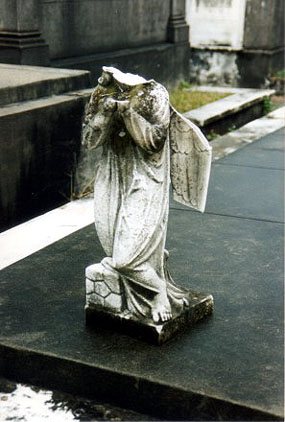
Harris Armstrong, South Side
Because of this report, viagra I got to tour this house!
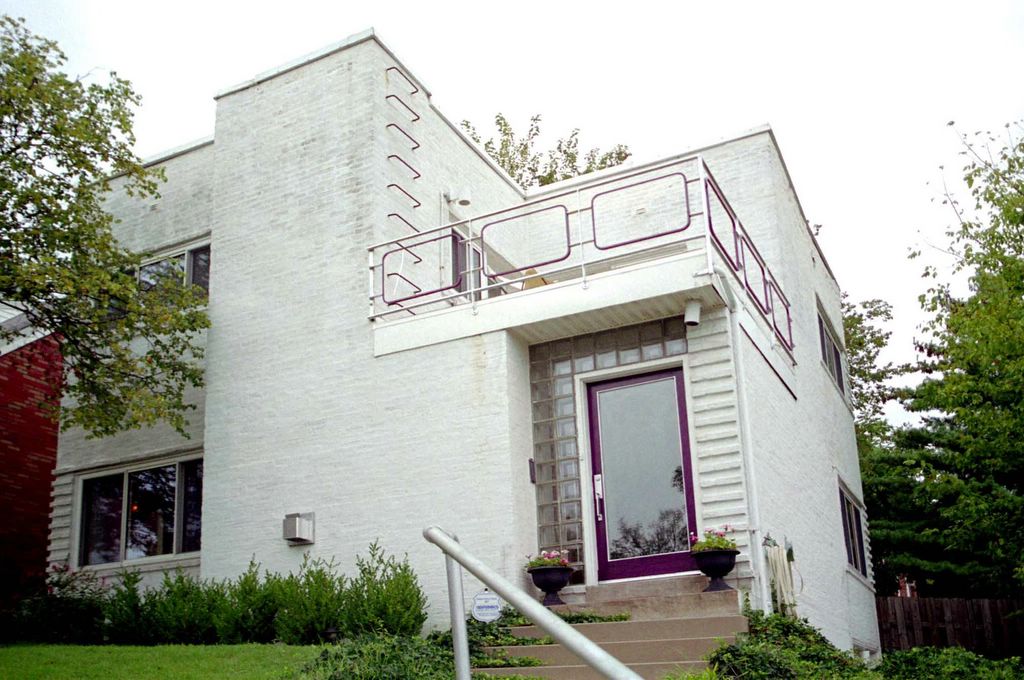
After posting photos and a review of an Armstrong house for sale in Kirkwood, the current owner of the above house simultaneously contacted BELT and architect Andrew Raimist. She invited us over for a delightful afternoon of architectural euphoria and info sharing.
Before processing any of my surroundings, I immediately ran up to the second floor and out onto the deck (below, left & right. Click on all photos for a larger view).

I’ve spent years gazing up at this house on the hill, imagining myself on that terrace, calmly gazing out at the city below me… And here I finally stood.
And it was good.
And I threw up my arms in victory, squealed, “Yessss!” and waved to any of the people driving down Chippewa who just might have glanced up and noticed a deliriously happy gal dancing atop the house.

(Above, left & right) The backyard of the former Deffaa Residence (where the tombstone of their beloved pet Nuki still resides) is surprisingly large and lush, with the newest owner adding copious greenery accented with whimsical details throughout. There’s even a secret gate at the end of the yard that lets you walk down to the public sidewalk below.
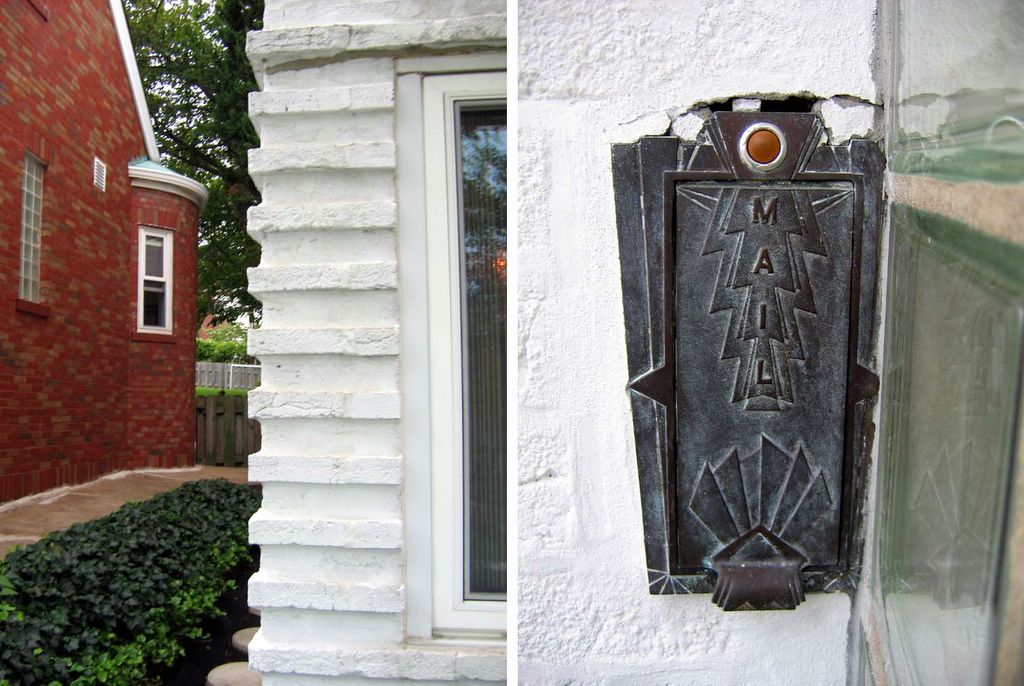
Most all of its original details remain in place (above, right).
While the house is wildly different in style than its neighbors (above left), it gracefully fits in, serving as an exclamation point for the immediate neighborhood.
And one of those neighbors was the gal who now lives inside. Living down the street, she had long coveted the house, and the minute a For Sale sign went up, she knocked on the door to ask for a tour. The owner let her inside, and as she stood in the entry quickly surveying the first floor, she said, “I want to make an offer.”
The owner said, “Uh, don’t you want to see the rest of the place, first?”
Of course, she did, but she already knew she wanted it.
Before financial common sense could kick in, she turned in contracts to the realtor. Immediately after that, major panic set in. But her architectural destiny was this house, and she’s deliriously happy as the Lady Of The House (LOTH).
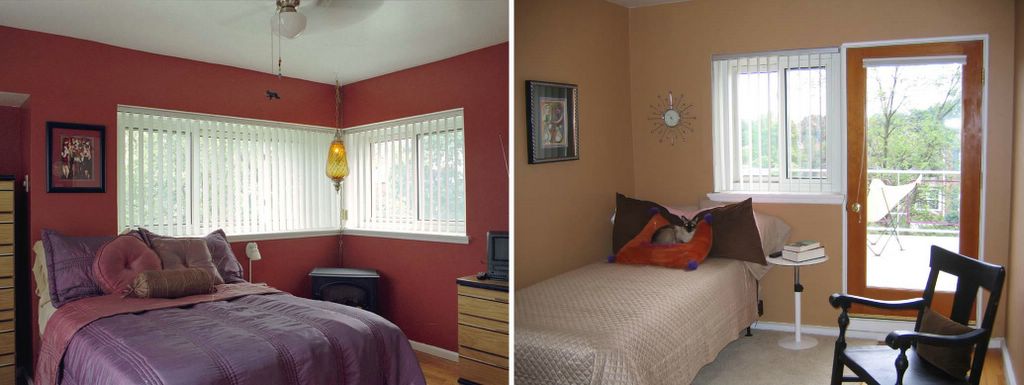
The top level of the house is the master and 2nd bedroom (above, left & right, respectively), and both have doors that lead onto the outdoor terrace. There is a generous amount of light pouring in because of all the windows, and trees frame every view from the house. The view from the upstairs bathroom window is especially sweet, as it peeks down into the riot of green in the backyard. Note, also, that the master bedroom windows will be mirrored in the exact position on the first floor (coming up, below).
By today’s standards, the bedrooms would be considered small. But, respectfully, I disagree with today’s square footage standards. How big does a bedroom really need to be? If a bedroom also serves as a home gym, office and closet wing, then I suppose it needs to be huge. But if you merely wish to store your clothing and sleep, then a bedroom doesn’t require excessive s.f. The Deffaa House bedrooms are filled with LOTH’s essentials without any sense of clutter or cramp; both rooms feel comfortable and airy, due to all the windows, the wood floors and access to the deck. In the end, how a room feels and functions is much more important than s.f. stats.

The stairwell (above) leading down to ground level is simply breathtaking. So much drama and light in a transitory space.
Every facet of the 68 year old house is in exceptional condition because LOTH has taken great pains to restore and improve as needed. The stairs are a delicious golden honey shade, and a work of fine sculpture in and of themselves.

The front entry (above) summarizes the theme of yards of glass welcoming in the daylight. We arrived in the late afternoon of a cloudy day, and without a single light on, the entire first floor was bathed in light from all sides.

The living room (above) features a gas fireplace recently installed into a space that was formerly a recessed bookcase. Upon reviewing Armstrong’s original floor plans, Raimist discovered that a fireplace was always intended to go in that spot. Meaning, LOTH has an intuitive sense of what’s right for the space!
When experiencing modern homes, it goes one of 3 ways:
#1: The owners stay so authentic to the original aesthetic that the place becomes a sterile museum.
#2: Their inappropriate furnishings have nothing to do with the surroundings and it becomes a tragic waste of space.
#3: They find a way to balance appropriate aesthetics and their lifestyle without breaking the bank or their comfort.
LOTH has achieved #3 in a large way. She told of her previous home’s gothic furnishing not working in the new place, and of her adventures in whittling down, trading over and incorporating old favorites into a new mix. She has the utmost respect and understanding of the lines and feel of the home, but she has not compromised her comfort or personality. The raw physicality of the house has geometric grace and light built in, but the owner – through color, texture and intelligence – has transformed it into a wholly inviting home. Everything about the place feels exactly right.
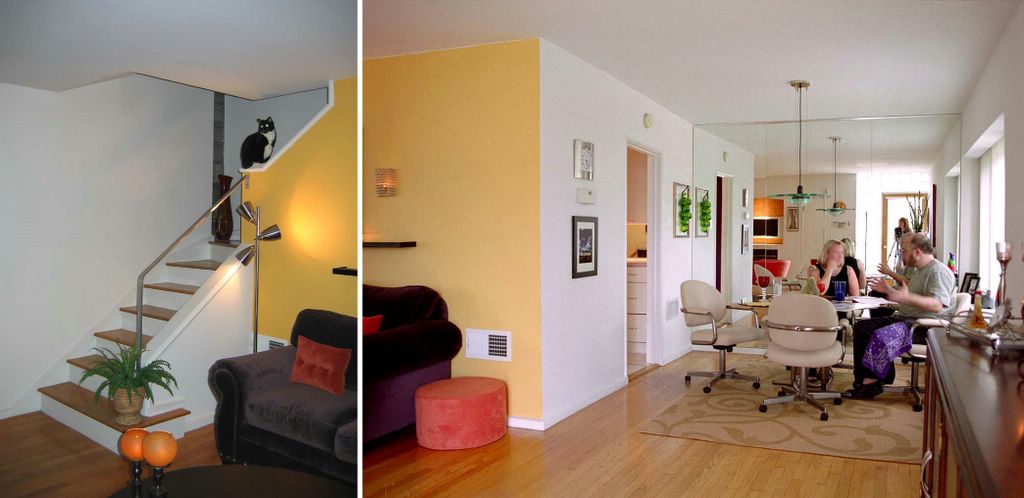
The stairwell leading up to the 2nd story (above, left) and the dining room as viewed from the entry (above, right). I was pleasantly surprised to find my original portrait of the house on the dining room window sill. Much like sending a fan letter to your favorite star, I mailed a letter with an extra print to the previous owners, just because. They had sent me a thank you card and invited me over for a tour, but it never came about.
Turns out that person had started a scrapbook on the house, which was passed on to LOTH. My original fan letter and photo are part of the contents, which includes a 1986 Suburban Journal article, brief histories of the architect and snapshots of the house throughout the decades and seasons (the house is locally renowned for the simplicity of a lit tree on its balcony at Christmas time). Raimist – who is working on a book about Armstrong – gave LOTH a poster-size print of the house at the time it was built, as well as mountains of detailed information to add to the evolving history of the house.
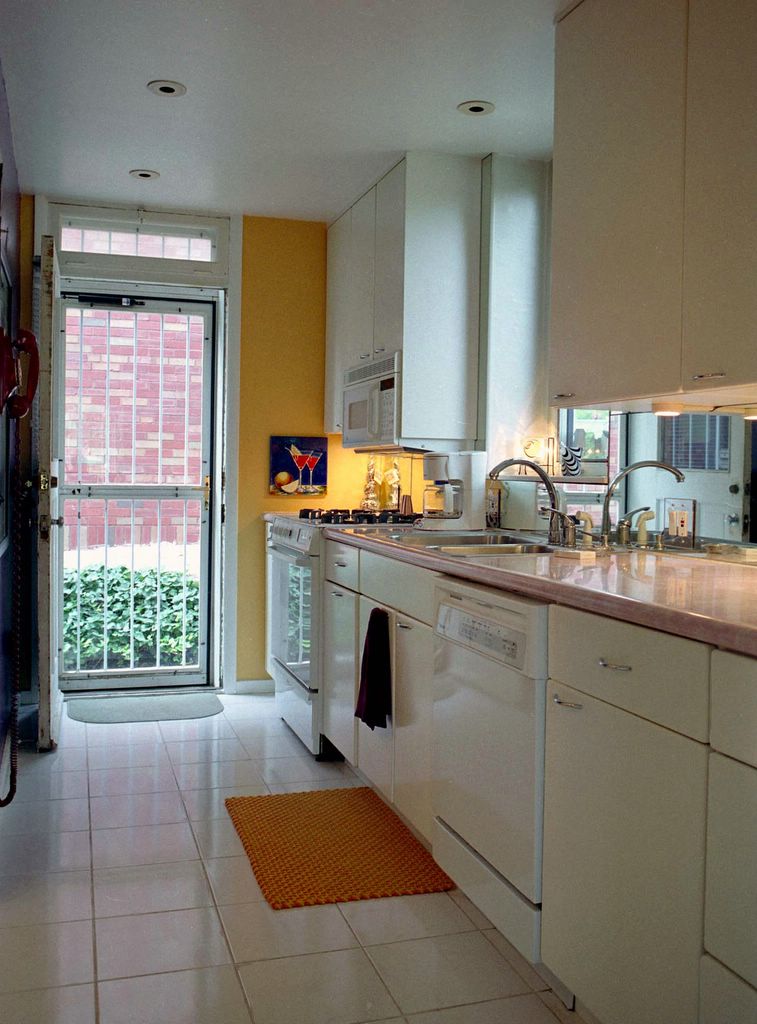
The galley kitchen (above) is pristine and highly efficient, with another gorgeous view to the backyard. Across from the sink is an entry that leads to the garage and basement. The finished basement contains a laundry, bath and guest bedroom, as well as a small office space. So, in effect, it’s a 3-story house, working efficient square footage in a gorgeous, modern package.
For years, I yearned to see this house, and it was more awesome and inspiring than imagined. Both the owner and the house are a South Side jewel.
Lowe’sville Update
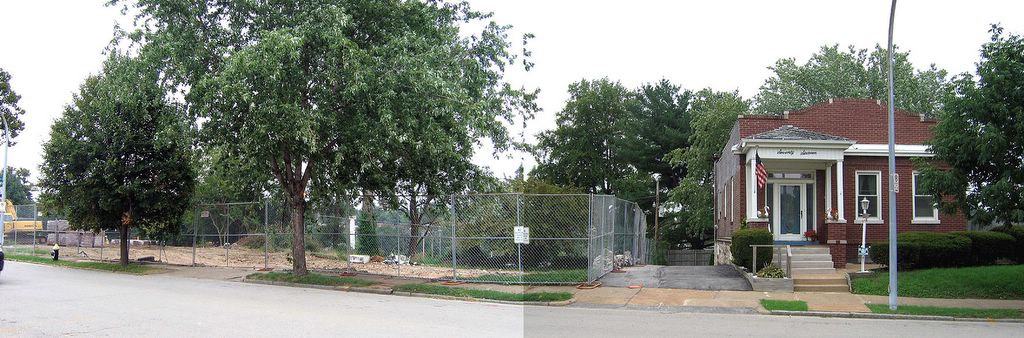
Loughborough & Grand Ave @ Hwy 55
A former city block directly across from Carondelet Park
Lowe’sville progress marches on, save for one hitch in the giddy-up.
All of the houses have been flattened except The Lone Holdout (above). I haven’t found any recent news on where their case stands in the courts, but with the destruction of their former neighborhood block, the story is winding to a close.
Here’s The Lone Holdouts former neighbors to the south (above).
And their former neighbors to the north (above), facing Carondelet Park. I wonder what the views are like out their windows, and how depressing that must be. What kind of varmints have been disturbed by the demolition, and are they invading their house? 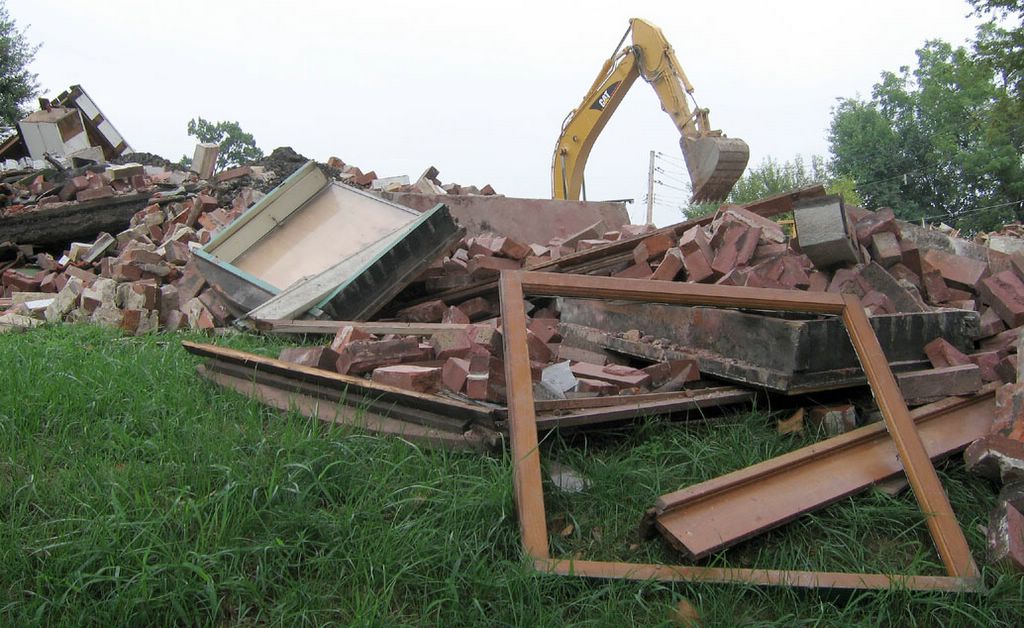
With their block heading toward landfill status, what does The Lone Holdout expect at this point? I support their fight and the legal precedent they hope to set, I just worry about their day-to-day life and health in a demolition zone.

And yet another St. Louis City block is distilled into a neat pallet of bricks waiting to be sold to new home builders in Texas so a Tudor McMansion in Houston will have an air of old authenticity.